
A design engineer is a designer who builds what they design in production code. On a software team, that means one person decides how an interface should look, move and behave, and then ships it as working front-end code, usually in React, Next.js and TypeScript, instead of handing a mockup to someone else to rebuild.
If you searched for "design engineer" and landed on job ads for CAD drawings and turbine parts, that is a different job with the same name. In mechanical and civil engineering, a design engineer designs physical products and structures. This article is about the software role, which has grown fast at product companies like Vercel and Adobe and is now one of the most useful hires a small startup can make.
The short answer
| Design engineer | UI/UX designer | Frontend developer | |
|---|---|---|---|
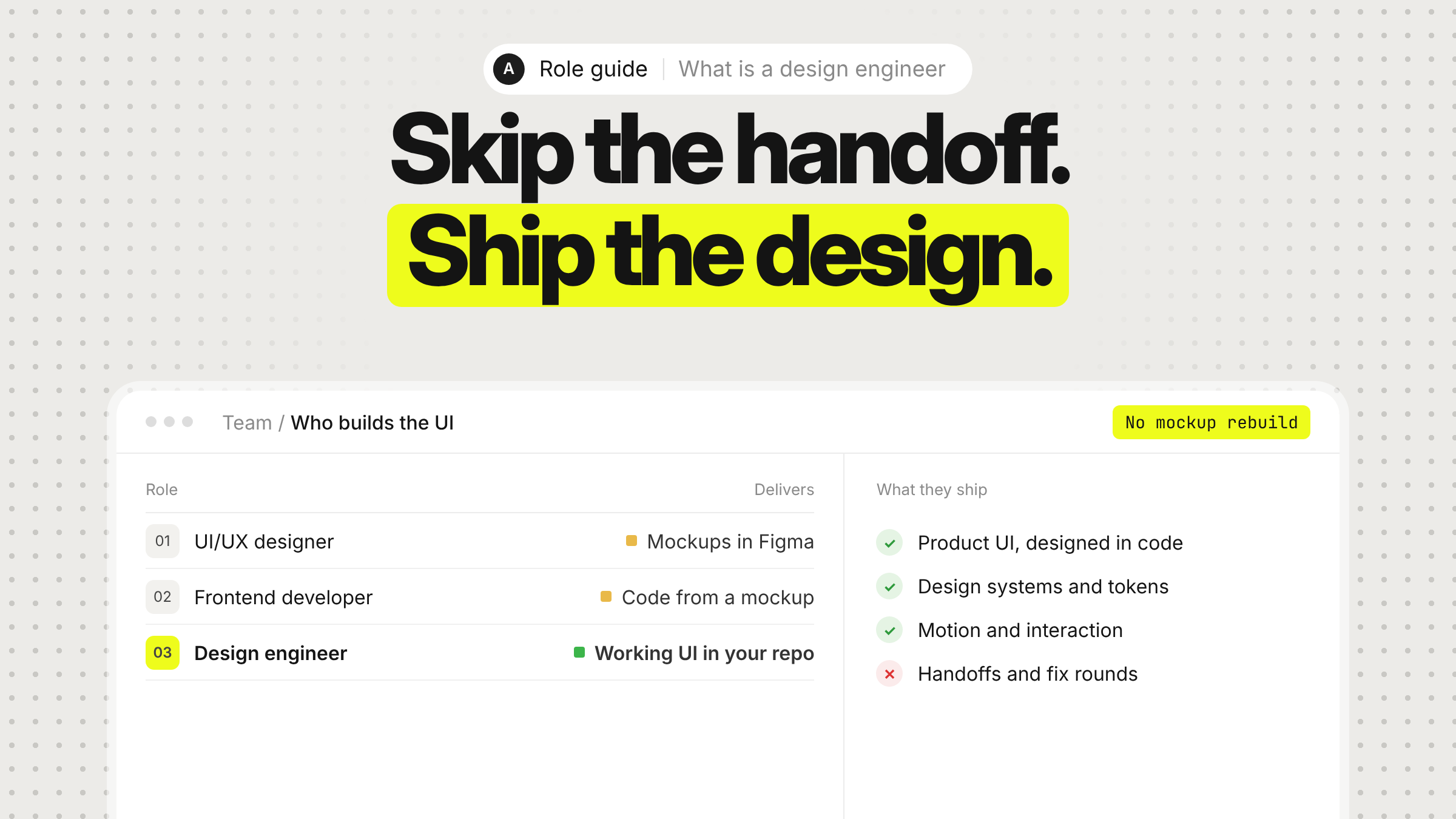
| Main output | Working UI in your codebase | Mockups and prototypes, usually in Figma | Code built from someone else's design |
| Makes design decisions | Yes | Yes | Rarely |
| Writes production code | Yes | Rarely | Yes |
| Handoff between design and code | None | Hands off to a developer | Receives a handoff |
| Best at | Product UI, design systems, motion, marketing sites | Research, flows, early exploration | Logic, data, performance, integrations |
A design engineer does not replace user research or backend engineering. What they remove is the gap in the middle, where a design file turns into a ticket, a ticket turns into code, and the result comes back looking slightly wrong.
What a design engineer actually does
The work changes from team to team, but most design engineers spend their week on some mix of these:
- Interface design in the browser. Screens, flows and states designed directly in code, so loading, empty, error and mobile states exist from the start instead of being discovered later.
- Design systems. Tokens, components and usage rules that the rest of the team can build on without asking a designer every time.
- Front-end build. Components and pages shipped to your repository as pull requests that engineers can review like any other code.
- Motion and interaction. Transitions, micro-interactions and the small details that make a product feel finished. These are hard to describe in a static file and easy to lose in a handoff.
- Accessibility. Contrast, focus states and keyboard paths built in as part of the work, not added the week before launch.
- Prototypes that are real. Instead of a clickable Figma prototype, you get a preview link of the actual product that you can put in front of users or investors.
Figma does not disappear. Design engineers still use it for brand exploration, quick sketches and stakeholder decks. It just stops being the deliverable.
Design engineer vs UX designer vs frontend developer
Versus a UI/UX designer
A product designer is the right person when the big questions are still open: who the user is, what problem you solve, which flow makes sense. They run research, map journeys and explore options quickly.
A design engineer takes over once the direction is clear enough to build. The difference shows up in what you review. With a designer you review a picture of your product. With a design engineer you review the product itself, on a preview link, with real data and real edge cases.
Many design engineers started as designers who learned to code. The good ones keep the designer's taste and add the ability to carry it all the way to production.
Versus a frontend developer
A frontend developer is the right person for complex application logic, state management, data fetching, performance work and integrations. They usually build from a design someone else made.
A design engineer covers the layer the user sees and touches. When a frontend developer gets a mockup, they have to guess at spacing, behavior and states that were never drawn. A design engineer makes those calls themselves, because they are the designer.
Why the role grew so fast
Two things changed. Front-end tooling (component libraries, Tailwind, modern CSS) made it practical for one person to build polished interfaces quickly. And AI coding tools like Claude Code and Cursor now handle much of the repetitive work, so a senior person can spend their time on design decisions and review instead of boilerplate. One design engineer can now cover what used to take a designer, a frontend developer and a lot of back-and-forth between them.
Skills to look for
If you are hiring one, or judging a team that claims to have them, look for:
- A real design portfolio. Typography, layout, color and motion that hold up on their own, not only code samples.
- Shipped front-end code. Public repositories, live sites or products they can point to. Ask which parts they designed and which they built; the answer should be "both".
- Fluency in your stack. For most startups that is React, Next.js, TypeScript and Tailwind or plain CSS.
- Systems thinking. Can they turn one good screen into components and tokens your team can reuse?
- Taste in the details. Hover states, loading states, transitions, empty states. These are where design engineers earn their keep.
- Comfort with AI tools, plus judgment. They should use coding agents to move faster and still review every line before it reaches your repository.
When a startup needs a design engineer
A design engineer is the best first design hire for many software startups, because they produce something users can touch, not something your engineers still have to build. You probably need one if:
- You have a vibecoded MVP that works but looks generic. Lovable, Bolt, v0 and Cursor get you to a working product fast, but the result often looks like every other AI-generated app. A design engineer can fix it in the same code instead of starting over in Figma.
- Your engineers keep rebuilding mockups. If every design goes through two or three rounds of "that's not quite what the file showed", the handoff is costing you more than the design.
- A demo day or fundraise is coming. Investors judge the product they can click. A design engineer can make the parts they will see look and feel finished in weeks, not a quarter.
- You need a design system before you hire more engineers. Getting components and tokens right early saves every engineer you add later from inventing their own buttons.
- Your marketing site needs to match the product. Landing pages with real motion and interaction are design engineering work.
You probably need someone else first if you have not talked to users yet (start with research and product design) or if your problems are mostly in the backend, data or infrastructure.
What a design engineer costs
Salaries for the software role are hard to pin down, because most salary sites mix it with mechanical design engineers. At startups and product companies, a senior design engineer is usually paid like a senior frontend engineer, and you also pay for recruiting, benefits, equipment and the months it takes to find the right person.
The alternatives look like this:
| Option | What you get | Typical cost |
|---|---|---|
| Full-time design engineer | One person, fully yours, after a hiring process that can take months | A senior engineering salary plus benefits and recruiting |
| Designer plus frontend developer | Two people and a handoff between them | Two salaries, or two freelancers to manage |
| Freelance design engineer | Flexible, but availability and quality vary | Hourly or per project |
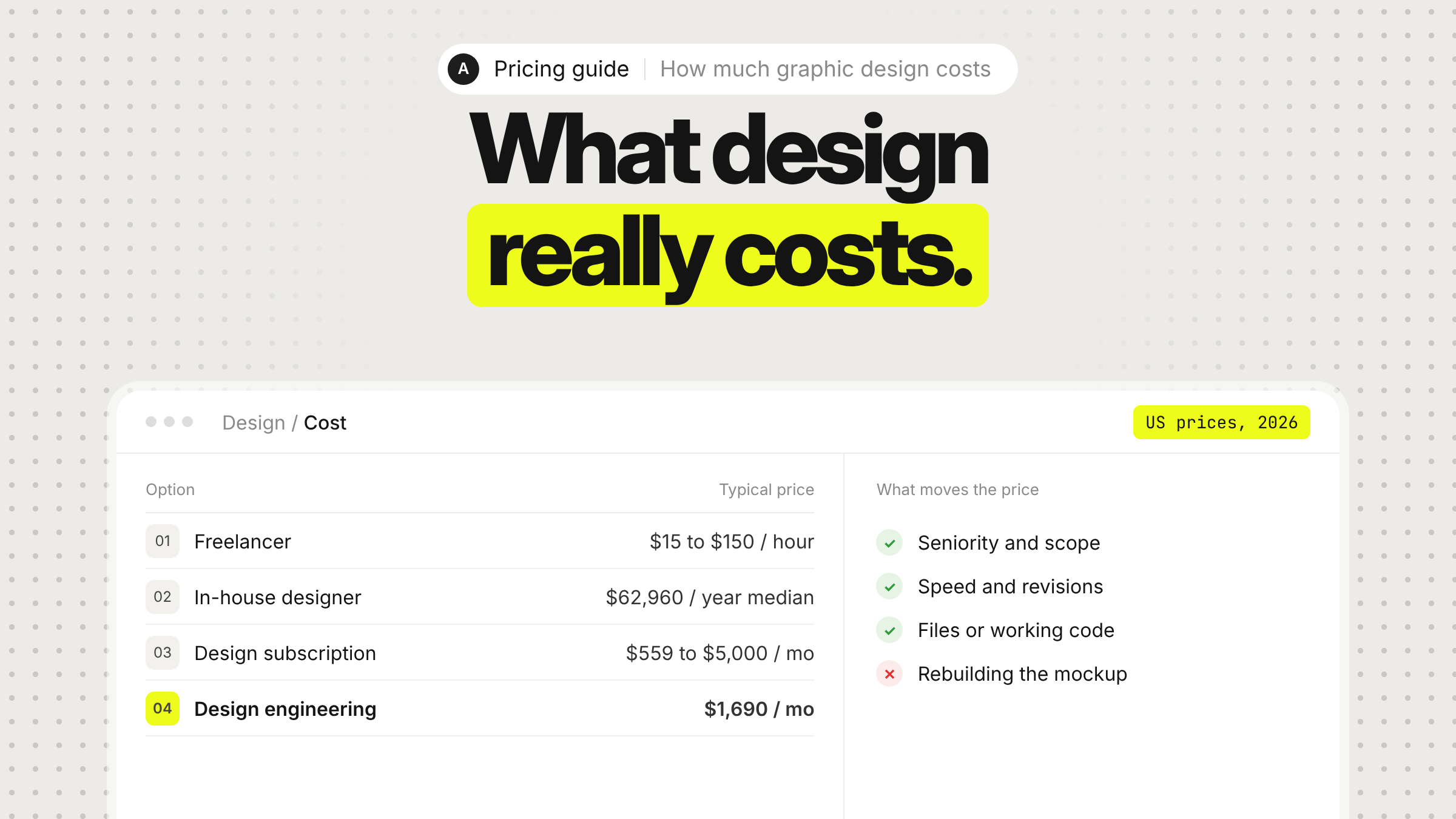
| Design engineering subscription | A senior design engineer working through your queue, with no hiring | $1,690 a month at Anivia Labs |
How we do it at Anivia Labs
Our Design Engineering plan gives you a senior design engineer for $1,690 a month. You add requests to a shared board, or send them from your AI through our MCP server, and we work through them in your priority order. Designs ship as pull requests to your own repository, and you review them on a live preview link instead of a static file. You get an update every working day, and you own everything from the moment it is made.
If you also need backend, mobile apps or AI features, the All-in-one plan adds engineers to the same queue for $2,490 a month. You can read more about how this changed design work in Design Engineering as a Subscription, or see which plan fits your stage in Which Anivia Labs Subscription Should I Choose?
Every plan starts with a 3-day free trial, so you can see real work in your repository before you pay.
FAQ
Is a design engineer the same as a UX engineer or UI engineer?
Mostly, yes. Companies use design engineer, UX engineer, UI engineer and creative technologist for overlapping roles. The common thread is a person who both designs the interface and builds it in production code.
Is a design engineer a designer or a developer?
Both. They make design decisions about layout, type, color and motion, and they write the production code that ships those decisions.
Do design engineers still use Figma?
When it helps: early exploration, brand work, or a deck for stakeholders. The final deliverable is code.
Can a design engineer replace a designer and a frontend developer?
For product UI, landing pages and design systems, usually yes. For deep user research or heavy application logic, you still want specialists.
What is the difference between a software design engineer and a mechanical design engineer?
A mechanical design engineer designs physical products and parts, usually in CAD software. A software design engineer designs and builds user interfaces in code. They share a title and nothing else.