
Graphic design costs anywhere from $15 an hour on a freelance marketplace to $15,000 or more a month for an enterprise creative team. For a startup, the realistic options are a freelancer at roughly $25 to $150 an hour, an in-house designer at around $63,000 a year before benefits, an agency at several thousand dollars a project, or a design subscription at roughly $700 to $5,000 a month.
For a startup, though, the hourly rate is the wrong place to start. A startup does not need pictures of a product. It needs design that gets users to sign up, understand the product and come back. Design that looks good but leaves the onboarding broken is expensive at any price. So this guide covers what each option costs, and also what you are actually paying for.
The short answer
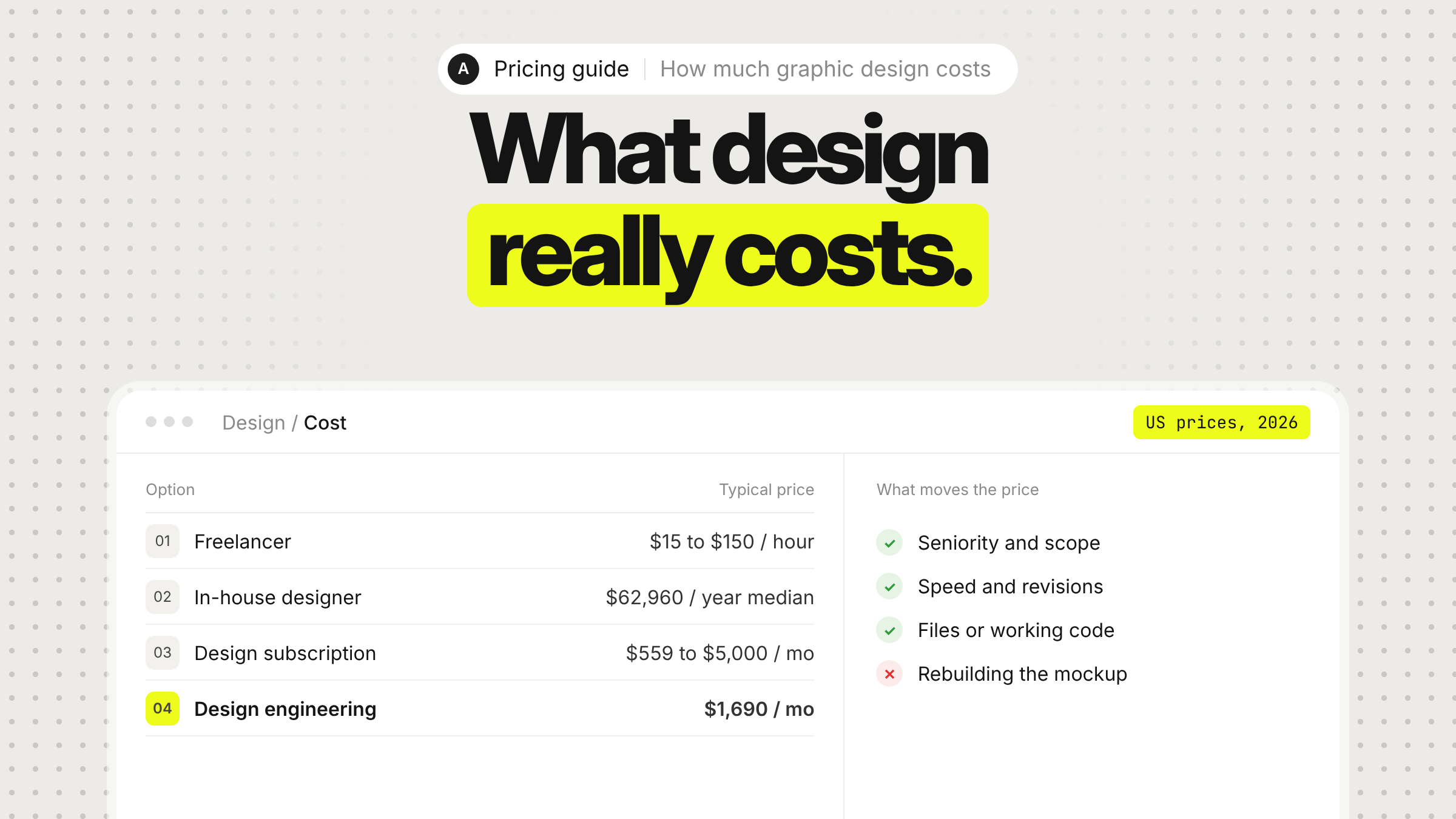
| Option | Typical price | Best for |
|---|---|---|
| Freelancer on a marketplace | $15 to $35 an hour is typical, up to about $150 for senior designers (Upwork) | One-off jobs with a clear brief |
| In-house graphic designer | $62,960 median salary in the US, before benefits, tools and recruiting (BLS) | Steady, full-time design volume |
| Design agency | Usually priced per project; agency retainers commonly run $5,000 to $10,000+ a month | Big launches and rebrands with a fixed scope |
| Design subscription | About $559 to $5,000 a month for most services; enterprise plans from $15,000 | Ongoing design work without hiring |
| Startup product and design team | $1,690 a month at Anivia Labs | Startups that need research, UX and design tied to growth, shipped as working code |
What drives the price
Five things move the number more than anything else:
- Seniority. A junior designer can execute a clear brief. A senior designer can tell you the brief is wrong. You pay for the second kind of judgment.
- Scope and volume. A single logo is a project. A steady stream of social posts, ads, decks and landing pages is a workload, and workloads are cheaper on a retainer or subscription than as separate projects.
- Speed. Rush fees, same-day turnaround and weekend work all cost extra, whatever the model.
- Revisions. Many freelancers and agencies include two or three rounds and bill beyond that. Subscriptions usually include unlimited revisions.
- What the deliverable is. A PNG for Instagram is cheaper than a brand system. A Figma mockup is cheaper than a working page, because someone still has to build the mockup.
The last point is the one founders underestimate. If your design work ends in a website or an app, the price of the design is only half the cost. You also pay a developer to rebuild it, and you pay again every time the result does not match the file.
Freelance graphic designers
Freelancing is the most flexible option, and the price range is the widest. Upwork puts typical graphic design rates at $15 to $35 an hour, with experienced designers charging up to about $150. Specialists in branding, motion or product design usually sit at the top of that range or above it.
To turn hourly rates into a budget, estimate the hours. A simple logo might take 10 to 30 hours, so at $35 to $100 an hour you are looking at roughly $350 to $3,000. A full brand identity with a logo, colors, type, guidelines and templates can take several times that.
Where freelancers work well: a clearly defined, one-off job, such as a logo, a single deck or a set of icons.
Where they get expensive: ongoing work. Every new request means finding availability, re-explaining your brand and managing deadlines yourself. Quality also varies a lot, which is why we wrote separate guides on what to watch for on Fiverr and Upwork.
Hiring an in-house graphic designer
The US Bureau of Labor Statistics puts the median pay for graphic designers at $62,960 a year (May 2025). On top of salary, budget for payroll taxes, benefits, software licenses, equipment and recruiting time. Senior designers and specialists in product or motion design earn well above the median.
Where in-house works well: you have a full-time stream of design work, and you want someone who learns your brand deeply and sits in your meetings.
Where it gets expensive: early-stage startups with uneven workloads. You pay for quiet weeks, and one designer rarely covers branding, product UI, marketing creative and front-end code equally well. Hiring also takes months.
Design agencies
Agencies usually quote per project, and the quote covers strategy, account management and a team rather than just design hours. A brand identity, website or campaign from an established studio commonly runs into five figures. Design Pickle's own comparison puts agency retainers at about $5,000 to $10,000+ a month.
Where agencies work well: a big, well-defined project like a rebrand or a launch campaign, where you want a full team for a few months.
Where they get expensive: anything that changes along the way. Fixed scopes mean change requests, and change requests mean new invoices.
Design subscriptions
A design subscription gives you a design team for a flat monthly fee. You add requests to a queue, they work through them, and you can pause or cancel. Prices vary widely depending on how many hours, designers or active requests you get. Here is what some of the best-known services list:
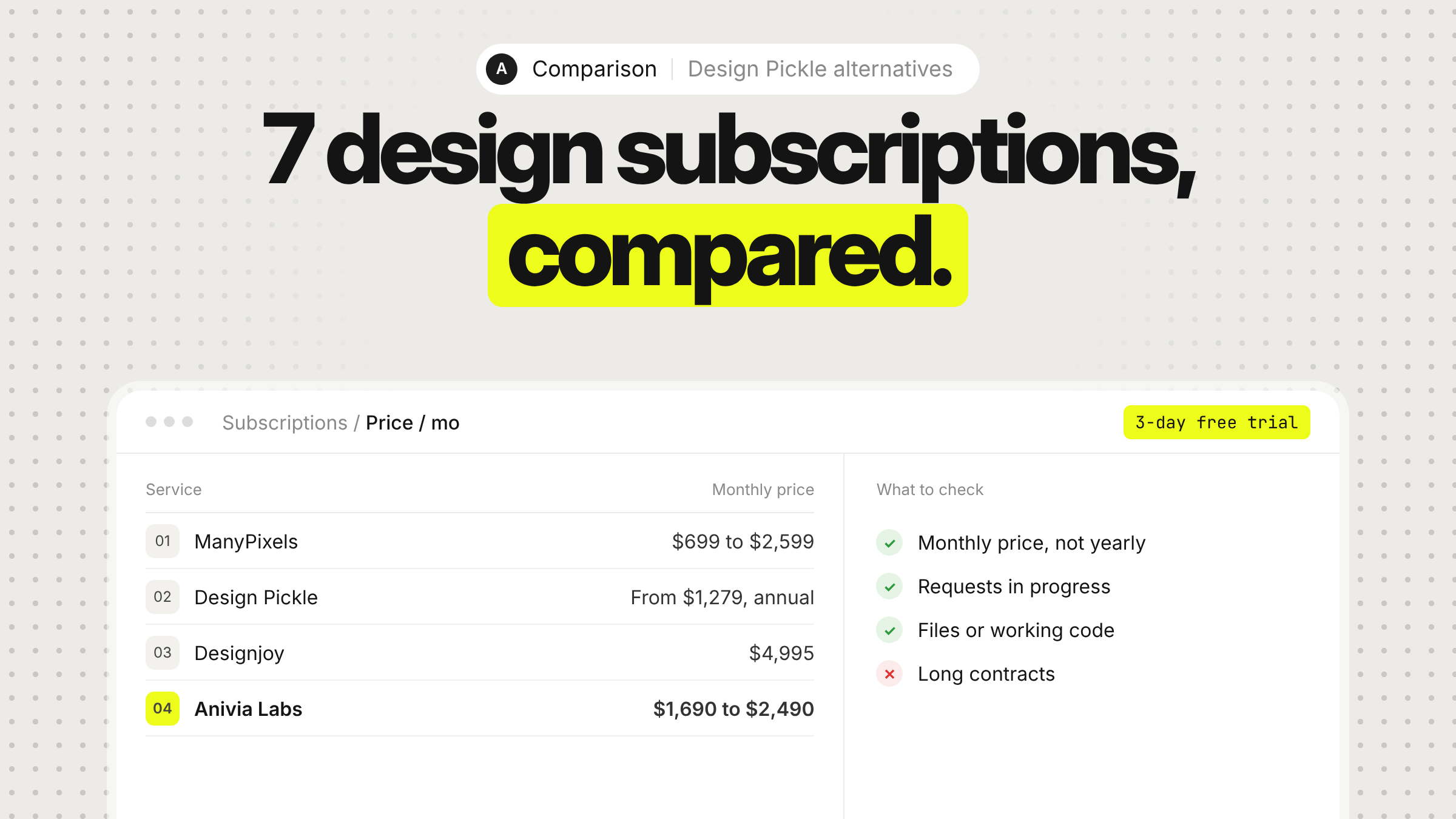
| Service | Monthly price |
|---|---|
| ManyPixels | $699 to $2,599 (from $559 billed yearly) |
| Penji | $995 to $4,500 |
| Anivia Labs | $1,490 to $2,490 |
| Design Pickle | From $1,279 billed annually; monthly pricing on a call |
| Kimp | $1,397 to $1,697 |
| Flocksy | From $1,699 for about 2 hours a day |
| Designjoy | $4,995, one plan |
| Superside | From $15,000, plus a software fee, on a 12-month term |
Prices are from each provider's pricing page or a Q4 2026 pricing index, and they change often, so check before you buy. We compare these services in more detail in Design Pickle alternatives.
Where subscriptions work well: steady design needs such as social graphics, ads, decks, landing pages and brand assets, without hiring.
What to check: whether you get a dedicated designer or a shared pool, how many requests run at once, turnaround times, whether yearly billing is required for the advertised price, and whether anything is actually built, or you only get files.
Graphic design pricing for common projects
These are rough ranges for a startup working with an experienced freelancer or a small studio. Agencies tend to sit above them, marketplaces below.
| Project | What drives the cost |
|---|---|
| Logo | Number of concepts, revision rounds, whether you get a simple mark or a full system |
| Brand identity | Logo plus colors, typography, guidelines, templates; usually several times the cost of a logo alone |
| Pitch deck | Number of slides, custom illustrations and charts, how much of the story needs work |
| Social media graphics | Volume per month; cheapest on a subscription |
| Landing page | Design only, or design plus build; build often costs as much as the design |
| Website | Number of templates, motion, CMS setup and who builds it |
| Product UI | Number of screens and states, plus a design system; almost always needs front-end work after |
Why startup design costs more than pixels
Most price lists, including the ones above, measure design by output: a logo, a set of banners, a number of screens. That works for a bakery that needs a menu. It does not work for a startup, where design has a job to do: get the right people to sign up, help them reach the moment the product clicks, and make them want to pay.
Design that does that job starts before anyone opens Figma:
- Market and competitor research. What the alternatives look like, what users already expect, and where there is room to stand out.
- User research. A few interviews or session recordings, focused on one question, to find where people get lost or give up.
- Data. Analytics and funnels that show where users actually drop off, so you fix the step that costs the most, not the one that bothers you most.
- UX and product decisions. Flows, onboarding and information architecture. Which steps to cut, what to show first, what can wait until version two.
- Design that ships and gets measured. Screens built as working code, released, and checked against the numbers that prompted the change.
A freelancer charging $30 an hour for screens and a team that does all of the above are not offering the same thing at different prices. They are offering different things. When you compare quotes, ask which of these steps are included, because the ones that are missing still need doing. Either you do them yourself, or nobody does and the redesign looks better without performing better.
| "Just design" | Design for a startup | |
|---|---|---|
| Starts with | A brief describing the screens | A business problem: low signups, weak activation, churn |
| Research | None, or your own notes | Market, competitors and users, sized for a startup |
| Data | Not part of the job | Funnels and analytics to find the biggest drop-off |
| Delivers | Files to hand off | Flows and UI shipped as working code |
| Success means | You approve the design | The metric moves |
Two costs that never appear on the invoice
The rebuild. If the design ends as a mockup, a developer still has to turn it into a working page, followed by rounds of "that's not what the file showed" and design QA. A design engineer designs and builds in one pass, directly in your codebase, so there is nothing to hand off and nothing to rebuild.
Design that solves the wrong problem. The more expensive mistake is a beautiful redesign of a flow that was never the reason users left. You pay for the design, the build and the months it takes to notice that nothing changed. A few days of research and a look at the data up front cost far less than that.
What Anivia Labs costs, and what you get
We work mainly with startups, and we treat design as a way to grow the business. Before we design a screen we look at your market, your users and your data, then design the flow that fixes the biggest problem and ship it as code. That means product design and UX research, not just UI, and on the All-in-one plan, product growth work such as funnel analysis, event tracking, A/B tests and conversion fixes.
Our Design Engineering plan is $1,690 a month. It covers product and UX/UI design, branding, and marketing materials such as decks, ads and social, delivered as front-end code or in Figma. The All-in-one plan at $2,490 a month adds product growth, backend, mobile apps and AI features to the same queue, so the people who find the problem can also build and measure the fix.
Both plans include unlimited requests and revisions, a dedicated lead plus senior specialists, an update every working day, and the option to pause or cancel anytime. You own everything we make. This is how we took Rendervi from an idea to 500 users in under three months. Every plan starts with a 3-day free trial.
If you are not sure which plan fits, Which Anivia Labs Subscription Should I Choose? walks through it by stage.
FAQ
How much does a graphic designer cost per hour?
On marketplaces like Upwork, typical rates are $15 to $35 an hour, with senior designers charging up to about $150. Specialists and studios often charge more.
How much does a graphic designer cost per year?
The median US salary is $62,960 (BLS, May 2025), before benefits, taxes, tools and recruiting.
Is a design subscription cheaper than hiring?
For most startups, yes. Most subscriptions cost less per year than one designer's salary, and you can pause when you have no work. The trade-off is that you share the team's attention with other clients.
Is a design subscription cheaper than a freelancer?
For one small job, no. For ongoing work, often yes, because you are not paying for briefing, re-briefing and project management each time.
What should a startup look for in a design partner?
Ask whether they start with your business problem or your list of screens, whether they do user and market research, whether they look at your analytics, and whether the design ends up as working product. A partner who only delivers files leaves the hardest parts to you.
Why do graphic design prices vary so much?
Seniority, scope, speed, revisions and the type of deliverable. A senior designer building a brand system and a junior designer resizing a banner are not doing the same job.