
A voice AI agent is a software program that can listen to natural language spoken by a user. It uses artificial intelligence to reason and respond in natural language, typically read aloud in real time. The AI agent can even call up other tools and programs and take actions such as scheduling an appointment or reading out the balance on a user’s account. However, behind every voice AI agent is a lot of complex engineering. Every part of the system can introduce latency. And the initial architectural choices can ‘lock’ a team into a particular vendor, price point and set of capabilities.
The rest of this document dives into the full voice AI agent architecture. It explains the core pipeline of a voice AI agent, where the delays in voice AI actually come from, how to evaluate a voice AI agent stack, and finally, when it makes sense to build a voice AI agent from scratch as opposed to purchasing a managed voice AI platform. Each point is grounded in the actual constraints that come with building real systems, including multilingual support and mobile usability, and AniviaLabs’ experience building Senthora, a voice-first language learning tutor for iOS and Android in seven languages.
Voice AI Agent Architecture: The Core Pipeline Explained
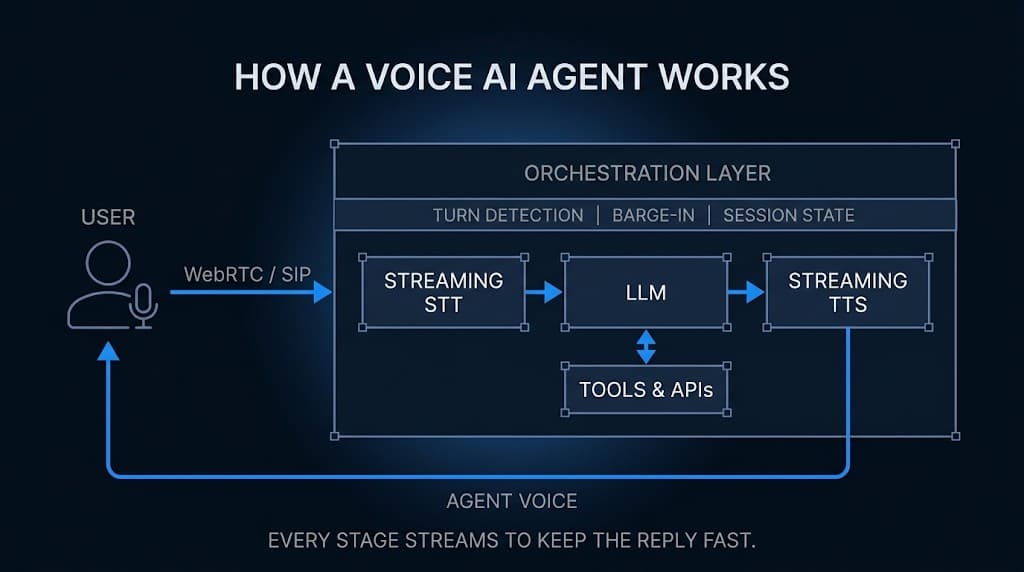
The typical Voice AI Agent architecture is to stream STT text to LLMs and then send the resulting LLM text to TTS. Each of these handoff points can add 100-400ms of latency, so the ability to stream at each point is critical.
Speech-to-Text: Streaming vs. Batch Transcription
Typical streaming transcription services like Deepgram and AssemblyAI continuously emit partial transcriptions which can then be used by LLM inference before the user has finished speaking. By contrast, batch STT waits until the end of an utterance and adds hundreds of ms to the time before the pipeline even starts to process.
LLM Inference: Turn-Based vs. Streaming Token Generation
The single largest variable in your pipeline is the LLM's time to first token. Fine-tuning a 7B-13B model usually yields faster performance than a frontier model on very narrow domains, but the accuracy trade-off has to be measured on real calls.
Text-to-Speech: Latency, Voice Cloning, and Emotional Range
TTS latency is usually determined by time to first audio (TTFA). Providers like ElevenLabs and Cartesia offer low-latency streaming models over WebSocket built for real-time agents.
Orchestration Layer: Where the Agent Logic Actually Lives
This layer holds turn-taking, tool calls, session state, and error handling, so it is where most production bugs appear and where build-vs-buy decisions carry the most weight.
Pipeline vs. End-to-End Voice Models: Choosing the Right Pattern
Deciding between a cascaded voice agent pipeline and a single unified speech model affects many downstream decisions related to latency, cost, and debugging.
What Speech-to-Speech Models Actually Change
OpenAI’s Realtime API and Gemini Live API natively process raw audio preserving the important aspects of speech such as prosody, tone, and emotion. They respond with lower latency and more natural prosody than a text-based pipeline. Note however that individual components of an end-to-end voice model cannot be swapped.
When a Modular Pipeline Still Wins
This modular architecture makes it very easy to swap out STT, LLM and/or TTS for different components and also generate very clean audit logs for each stage of the voice model.
Hybrid Architectures: Combining Perception with Modular Control
A common hybrid runs the live conversation on a speech-to-speech model and hands complex reasoning or tool calls to a text-based LLM, or routes simple turns to the speech model and complex ones to the pipeline.
Latency Engineering: Hitting the Sub-500ms Target in Production
The five stages of end-to-end voice agent latency include endpointing, STT transcript generation, LLM first token generation, time to first audio, and network latency. Each stage’s latency can add up in compound fashion.
Measuring the Right Latency Metric: TTFR, TTFA, and Perceived Response Time
A good metric for perceived response time is voice-to-voice latency: the time from the end of the user’s utterance to the first audio of the agent’s reply. Around 800ms is a common production target, and roughly 500ms starts to feel natural. Track it at p50 and p95 on a production dashboard rather than as an average.
Streaming, Speculative Execution, and Response Pre-Generation
Sending the first complete sentence of the LLM response to TTS while subsequent tokens are still generating reduces perceived latency noticeably without modifying the existing model. In addition, pre-rendered audio for the most common phrases (e.g. greetings) can be cached, to skip entirely the TTS synthesis for such turns.
Infrastructure Choices: Edge Deployment and WebSockets
By placing the STT and TTS inference close to the telephony provider of the user, edge deployment of voice agents can remove up to 150ms of network latency from the chain. Furthermore, the use of WebSocket-based streaming voice agents as opposed to polled-based agents reduces connection overhead, and WebRTC is a good choice for both browser and mobile-based voice agents, while SIP is best for traditional phone calls.
Turn-Detection Tuning: Avoiding False Starts and Awkward Silences
The VAD thresholds for turn detection in particular determine the post-pause wait time. Aggressive thresholds here cause interruptions in the middle of sentences; conservative thresholds cause excessive amounts of dead air. A semantic turn detector, which checks whether the user’s sentence sounds complete, can alleviate both of these problems, though it still needs testing per language and use case.
Stateful Conversation Design: Context, Memory, and Multi-Turn Handling
Voice agent conversation design fails without a good state layer. A multi-turn voice agent in production has a session store, fast tool calls, and clean interruption handling.
Session State vs. Persistent Memory: What Your Agent Needs to Remember
Stateless agents are only good for single-turn Q&A. A session store such as Redis can persist the context of a call across turns, i.e. to keep track of intent, collected slots and previous answers.
Tool Calling and Real-Time Data Retrieval Inside a Voice Turn
Every tool lookup inside a voice turn adds to the silence the caller hears, so slow lookups need a short spoken filler such as “let me check that” while they run. For knowledge-heavy use cases, a retrieval layer usually beats packing everything into the prompt, as covered in fine-tuning vs RAG vs prompt engineering.
Handling Interruptions, Barge-Ins, and Topic Switches Gracefully
Barge-in support requires careful integration of VAD with TTS playback and a cancellation signal that stops LLM generation when the user starts speaking. Most managed platforms handle this, but quality varies considerably, which makes it a useful test when evaluating platforms.
Voice Agent Stack: Evaluating the Key Vendors and Components
Determine the best voice agent components for STT, TTS and orchestration rather than choosing a single platform for your AI voice agent development.
STT Providers Compared: Deepgram, AssemblyAI, Whisper
Deepgram is very fast and cost efficient for real-time AI voice development. AssemblyAI generates punctuation and speaker diarization. Self-hosted Whisper keeps audio on your infrastructure, but it is not built for streaming and needs extra engineering for real-time use.
TTS Providers Compared: ElevenLabs, Cartesia, Azure Neural
ElevenLabs and Cartesia Sonic are amongst the lowest-latency, natural prosody TTSs available. For regulated industries, requiring data to reside within particular geographical regions, Azure Neural is typically the preferred choice.
Orchestration Platforms Compared: Vapi, Retell AI, Bland AI, LiveKit Agents
A key comparison is Vapi vs Retell AI as a managed STT+LLM+TTS+telephony API behind a single API call. Bland AI is purpose-built for high-volume outbound use cases. Lastly, LiveKit Agents provides an open-source WebRTC media orchestration solution for developers building full voice-powered agents.
Build vs Buy Voice AI: A Decision Framework for Founders and CTOs
Five dimensions determine whether a custom build or a voice platform is more suitable for your organization: time-to-market, customization, call volume, data protection, and ML capabilities within your organization.
When Buying a Voice AI Platform Is the Right Call
Buying fits when shipping fast is more important than voice AI differentiation, call volumes are moderate, and the application follows a standard template like booking appointments or lead qualification for potential customers.
When Building a Custom Voice AI Agent Pays Off
A custom voice AI agent is required when a product has proprietary voice personas, sub-300ms latency SLAs, on-premise data processing and/or deep integration into internal systems which cannot be reached by a platform. At high call volumes, per-minute platform fees can exceed the Total Cost of Ownership (TCO) of a custom stack, so the break-even point is worth modeling against real traffic.
The Hybrid Path: Platforms With Escape Hatches
Using a platform such as Vapi for orchestration and telephony while plugging in your own choice of STT, TTS, or LLM keeps most of the launch speed of buying and still leaves plenty of room to customize.
Guardrails, Safety, and Compliance in Production Voice Agents
Production voice agents need guardrails that fit inside the latency budget, clear compliance handling, and a path to a human.
Preventing Hallucination and Off-Script Behavior in Live Calls
Rule-based guardrails, such as blocked topics, allowed actions, and scripted fallbacks, add almost no latency to a turn. A secondary LLM classifier that checks every response is safer but adds delay on top of STT and TTS, so it fits high-risk actions better than every sentence of a real-time conversation.
PII Handling, Call Recording Consent, and HIPAA/GDPR Considerations
Call recording consent rules differ across US states, and some require every party to agree, so the agent should disclose recording at the start of the call. Since 2024, the FCC treats AI-generated voices as artificial voices under the TCPA, so outbound AI calls need prior express consent. In the EU, voice recordings are personal data under GDPR and need a lawful basis for processing. Within a HIPAA-regulated environment, every vendor in the stack that handles patient data must sign a Business Associate Agreement (BAA), and PII must be masked or kept away from any component without one.
Monitoring, Alerting, and Human Escalation Paths
Sentiment shifts, repeated misunderstandings with the voice agent, and explicit requests for human escalation should all be monitored. Rules for determining when to send a customer to human support should be easily configured without requiring code deploys to update rules that are managed in a dashboard.
How to Build an AI Voice Agent: From Prototype to Production
The Right Sequence: Prototype, Load Test, Then Productionize
First, validate your conversation design on a managed platform like Vapi or Retell AI. Get real data from 1,000 real calls and find out all the edge cases your beautiful design didn’t anticipate. Then move to a custom build only if the build-vs-buy factors above point there.
The Minimum Viable Voice Agent Stack for a 4-Week Build
A typical voice AI development stack could look something like Deepgram for STT, a small, fast LLM with streaming for LLM, Cartesia for TTS, LiveKit for media server, Redis for session state, and Twilio for telephony.
Key Metrics to Track from Day One of Production
For production voice AI agents, track call completion rate, average handle time, barge-in frequency, STT word error rate, and CSAT scores. Use a latency regression test suite to catch silent regressions, since swapping in a new TTS model can add latency without triggering any errors.
Conclusion
Building a voice AI agent is a fundamental architectural choice that will significantly impact latency, cost and scalability for years to come. Choosing between a cascaded STT-LLM-TTS architecture and a single speech-to-speech model such as OpenAI Realtime API or Gemini Live API has significant implications for controllability, debuggability and tool calling. Managed platforms such as Vapi or Retell AI are great for speed, but custom stacks become increasingly relevant when voice is core to your product or when per-minute fees start to matter at scale. Founders and CTOs can dive deeper into the ins and outs of the framework outlined above and then map out their own AI stack. Alternatively, they can also find out what a custom build actually entails by reviewing the development services offered by AniviaLabs.
FAQ
What is the best voice AI agent architecture for a production system?
For most production deployments, a modular architecture is the safer default. Each piece of the pipeline (speech-to-text, language model for reasoning, text-to-speech) can be a different component, and you can have lots of control over the tradeoff between cost and latency for each part of the stack. While end-to-end models that bundle together the entire pipeline in a single neural net are increasingly popular and even lower latency than a modular architecture, for now the modular architecture is safer for founders and CTOs to use until end-to-end models are more mature.
How do you reduce latency in a voice AI agent to under 500ms?
Hitting sub-500ms response time requires streaming at every stage: streaming transcription, a smaller or fine-tuned LLM, and speech synthesis that starts before the LLM has finished responding. Similarly, hosting all components of the pipeline in the same region as your LLM, caching responses, and precomputing many frequent responses can all add up to significant performance improvements for high-volume production deployments.
Is it better to build a custom voice agent or buy a platform solution?
When it comes to the build-vs-buy decision of Voice Agents, it mostly comes down to three factors: differentiation, timeline, and ML expertise. For founders and CTOs that are looking to get to market quickly and validate a Voice Powered Interface for their customers, the use of a Platform such as Bland, Vapi or Retell is the best course of action.
What is an AI voice agent?
An AI voice agent is software that listens to a caller or app user, understands the request with a large language model, and answers in a natural synthesized voice in real time. Unlike an IVR menu, it handles open-ended speech instead of keypresses and fixed phrases, and it can call tools to take actions such as booking an appointment or checking an order status.