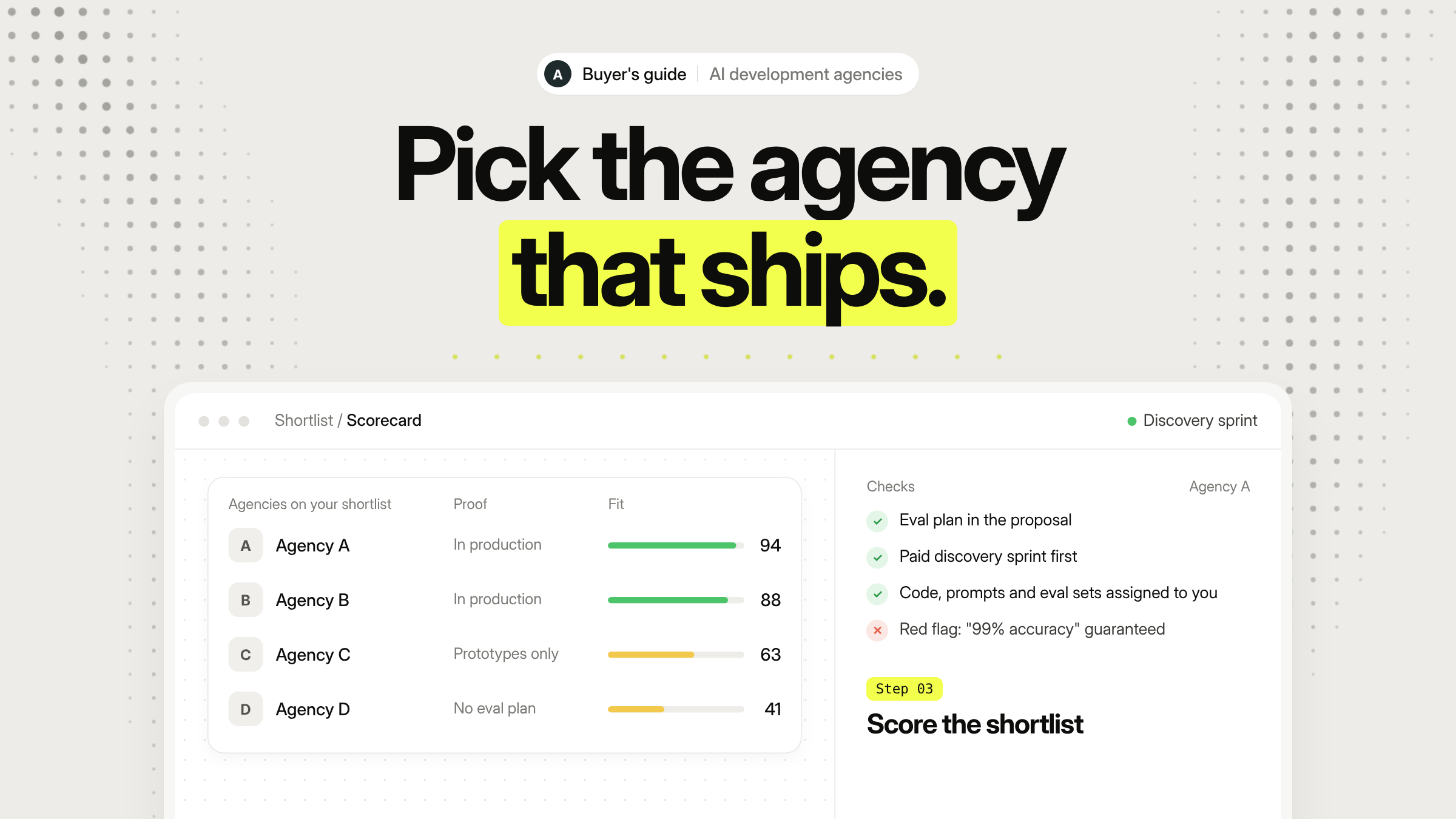
Choosing an AI development agency to ship your product as opposed to developing an expensive prototype that will never reach your users is the single most important decision you can make. Paper credentials are not talent. Meaningful AI development in production, evaluation suites, monitoring of output for drift, and mitigating prompt injection in real-world scenarios are key differentiators. Agencies who build amazing demos to hand off to other agencies to break slowly in production have not done AI development.
It's 2026, and many "AI experts" have recently sprouted up from the core of existing web development agencies by slapping a thin model wrapper around their core service. To sift through the resulting sea of mediocrity and uncover true production expertise, one must investigate in some detail before committing to a Statement of Work. The remainder of this article sets out a series of inquiries that can be addressed to any potential vendor to constitute a considered procurement.
Why Choosing an AI Development Agency Is Different From Hiring a Regular Dev Shop
When looking for external partners to do AI work, the risks are different from those typically associated with hiring a software vendor. Thus, failure modes are different from what you are used to, and typical evaluation tools won't help you.
The Gap Between AI Demos and Production-Ready Systems
Production AI is not the same as wrapping an LLM API call in a prototype. A competent developer can do that in a few days, but then there is the matter of latency, inference cost, data grounding, etc., as well as how to gracefully degrade when the model starts to hallucinate.
Why Traditional Vendor Scorecards Fail for AI Projects
The standard RFP criteria for evaluating the qualifications of potential external partners (e.g. team size, years of business, technology stack) are poor indicators of success with production AI systems.
What AI Project Failures Have in Common
The most common evaluation errors for founders selecting AI vendors form a pattern. They are: 1) no framework for evaluation; 2) inference costs spiraling out of control; and 3) founders have not articulated the requirements in sufficient detail to test for them. Thus it is wise to treat hiring a vendor for production AI work as hiring a technical co-founder rather than purchasing a non-differentiated service.
Define Your AI Outcome Before You Talk to Any Agency
Poorly scoped goals create poor scope for vendor proposals and therefore result in lengthy discovery phases, even with productive agencies.
Outcome-First Scoping: What Does Success Look Like in 90 Days?
AI project scoping starts with a concrete target and not with a list of capabilities that one would like to have. Instead of "Add AI to our product" one should aim for something like "Reduce time to resolve support tickets by 40% using an LLM powered triage chatbot". Define how this target will be measured and tested before the first call.
Distinguishing AI Features From AI Products
The differentiation between an AI feature and an AI product affects the choice of partner for the respective scope. An embedded copilot in your SaaS product requires a different architecture and a different team than the development of a completely new AI product. An AI MVP framing is thus very helpful to scope early and clearly.
How to Write a One-Page AI Brief That Agencies Can Actually Respond To
Key for successful AI projects is a good brief that has 4 components: the problem, the data you have, the change to user interaction required and the success metric. If the AI development agency on the first call does not have any clarifying questions on data or the measurement approach then there is a process gap that you should be aware of.
The Core Technical Capabilities to Vet in Any AI Development Agency
Capability claims are easy to make. And hard to verify. So, here are 4 areas where you can put a team's production experience under fire with a structured set of questions.
RAG and Data-Grounding Expertise: The Questions to Ask
Specifics on RAG expertise are key. How does a partner approach chunking strategies? What embedding models have they employed across different types of corpora? And, most important, how does a partner measure the quality of retrieval prior to generation of answers? A team that can also explain when RAG is the wrong choice compared with fine-tuning or prompt engineering has usually shipped it in production.
Multi-Model Strategy and Model-Agnostic Architecture
Multiple providers are needed for most use cases, and thus the team must understand the trade-offs between models from OpenAI, Anthropic and Google for a specific goal. Companies locked into one provider have real vendor risk.
Evaluation Frameworks, Evals, and LLMOps Pipelines
Real AI development companies have production proven eval frameworks. LLMOps needs to have prompt regression testing as well as drift monitoring in production, not just some metrics which get reported once for a launch. Teams that map their testing and monitoring practices to a recognized reference such as the NIST AI Risk Management Framework tend to have a more mature process.
AI Agent Development and Orchestration Experience
Ask how the team approaches agent development, including use of orchestration frameworks (e.g. LangGraph, CrewAI), handling of tool-call failures, connecting agents to products through protocols like MCP, and design of human-in-the-loop checkpoints. Invite the engineers from the company for a technical session.
How to Read an AI Agency's Portfolio and Case Studies
An AI agency portfolio often tells you more about the real depth of their production capabilities than any sales call would. Note the things that are not mentioned in their slick case studies.
Production Experience vs. Prototype Experience: How to Tell the Difference
Prototype-only shops can build cool demos. However, their portfolios show little understanding of inference cost optimization, model versioning, and production monitoring. Look for p95 latency numbers, cost-per-query numbers, and accuracy benchmarks that were measured on production-like traffic.
The Right Questions to Ask About Past AI Projects
Ask what broke after launch and how it was fixed. This question filters out people with very shallow experience really fast. If they can't give you any detail about how they overcame specific challenges then you know you're dealing with someone who's never actually shipped production quality AI in real life.
What a Strong AI Case Study Actually Contains
Look for credible case studies from potential AI development company partners. These studies should describe the environment and data used, the evaluation methodology, the model selection rationale, and last but not least, the measurable outcomes after the AI has been put into production.
AI Development Agency Red Flags That Founders Miss
Spotting AI agency red flags early saves months of rework. These are patterns in proposals from outfits trying to win your work and ship software that will cost you later.
Overpromising on Accuracy and Timelines
Warning signs for any AI development company start with the vendor guaranteeing "99% accuracy" for a given LLM task without ever mentioning a specific benchmark for said evaluation. They either don't know better or are intentionally trying to mislead you. A fixed price quote for the whole AI development process within 24 hours, without having gone through a proper discovery process first, is clearly not good for you.
No Evaluation, Testing, or Monitoring Plan
By not having an evals section or post-launch observability in the proposal, the agency is treating your AI product as if it were a static web app. Likewise, data privacy and security issues such as prompt injection and sensitive information disclosure, both covered in the OWASP Top 10 for LLM Applications, can quickly become huge problems if they are not addressed early, especially if your SaaS product collects user data.
Lock-In Through Proprietary Platforms
Founders who want to hire AI development team resources through an external agency should ensure the contract guarantees that they retain control of the infrastructure configs, prompts, and eval sets for the AI developed.
Engagement Models: How AI Development Agencies Structure Their Work
Structuring your AI agency engagement is as important as selecting the right vendor to deliver on your AI ambitions. It affects how fast you can go, how efficiently knowledge can be transferred and whether unwanted long-term dependencies appear.
Fixed-Scope AI MVP vs. Iterative Retainer: Which Fits Your Stage
AI MVP development is typically structured as a fixed scope project of 4-8 weeks that produces a testable artifact with bounded risk. After product-market fit, SaaS teams are better off with an AI development retainer that allows for ongoing model fine-tuning, feature additions and LLMOps without renegotiating scope for each cycle.
Embedded Team Model vs. Full Outsource
An embedded model means the agency's engineers sit within your repo, your Slack channels and participate in your sprints. They may move faster initially than a full outsource but create a similar structural dependency as the engagement comes to an end.
How to Structure a Paid Discovery Sprint Before Committing
Expect any reputable AI product development firm to agree to a paid discovery sprint of 1-2 weeks before committing to a full engagement with a structured scope of work. Evaluate how they handle ambiguity, how they communicate trade-offs and the structural decisions they make in that short sprint.
Contract Terms to Negotiate in 2026
The terms and conditions of a contract are critical to ensuring the success of an engagement involving AI.
IP Ownership, Model Weights, and Data Clauses to Insist On
Full ownership of all code, prompts, fine-tuned model weights and evaluation datasets should be assigned to the client. No use of a client's proprietary data or work for other projects.
Milestone-Based Payment Structures That Protect Both Sides
Split payments into milestones: project start, completion of a test version, and a production ready version. This way payments are linked to delivery of actual work.
How to Run a Structured Shortlist Process for an AI Agency
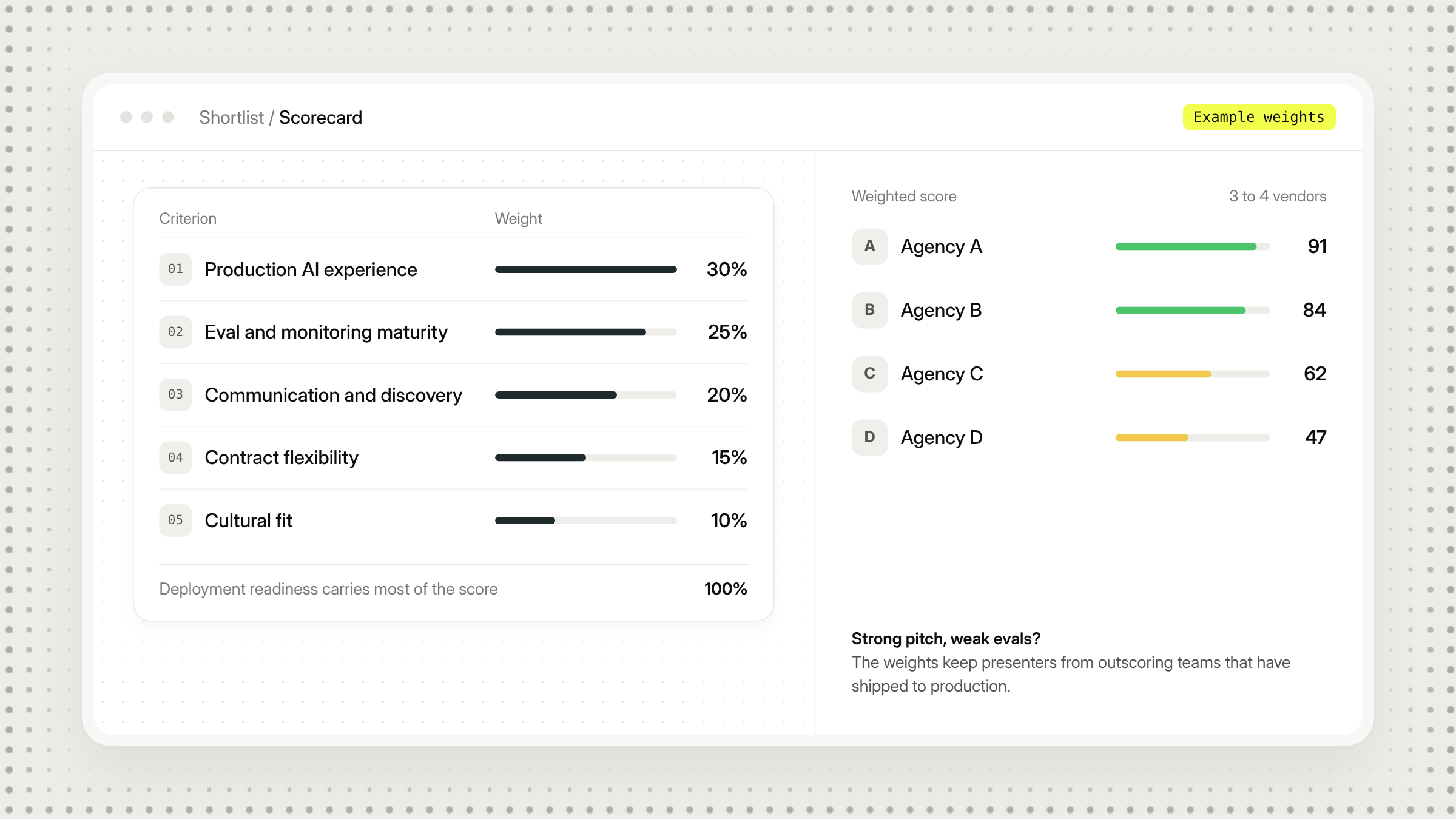
Keep your shortlist of potential AI agencies to three to four vendors in order to avoid information overload and have truly in-depth conversations with each potential partner.
Building a Scorecard That Weights AI-Specific Criteria
An example distribution weights production AI experience at 30%, eval and monitoring maturity at 25%, communication and discovery quality at 20%, contract flexibility at 15%, and cultural fit at 10%. This keeps the core of your decision criteria focused on deployment readiness while ensuring that your shortlist of AI development companies does not consist solely of presenters.
The Technical Challenge or Paid Test to Include
Evaluate the reasoning capability of a shortlisted AI development agency by giving them a small paid task (e.g. sample dataset + user story) and then asking them for an architecture proposal plus the 3 biggest risks for the given user story. Don't just judge output, judge the process too.
Reference Checks: The Three Questions That Reveal the Most
When evaluating a shortlisted AI agency, ask their references 1) what did the vendor get wrong and how did they fix it, 2) did the final system actually perform as benchmarked in the proposal, and 3) would they grant that same team of engineers access to their production data again.
Make the Right Call: Choosing the AI Development Agency That Fits Your Stage
By far the biggest reason that many AI engagements with early-stage startups don't actually get to shipping anything real is stage mismatch.
Matching Agency Profile to Company Stage and AI Maturity
Pre-seed founders need someone who is comfortable with ambiguity and wants to co-build a product with them. Series A teams with existing engineers on the other hand need an AI product development partner that can embed, upskill and hand over to them as smoothly as possible.
When to Choose a Boutique AI Studio Over a Large Consultancy
A large consultancy is very enterprisy, and set up to deal with all the red tape and other hurdles of serving large enterprises. Thus, if the choice is between a focused AI studio and a brand name consultancy, an early-stage team is usually better served by the focused studio.
Your Next Step: From Shortlist to Signed Agreement
Run a scoped AI MVP project first, then lock in that company with a retainer. Starting with a scoped project is the lowest risk way to test technical ability and working fit, and to see whether the team sets up an evaluation framework before it starts writing code. Explore development services
Conclusion
When choosing an external partner, look for production evidence over beautiful demos. Evaluate potential partners against this evaluation framework, which covers defining a clear outcome brief, checking for evaluations, observability and LLM security, reading their portfolios for evidence of real deployment work, identifying potential problems before signing them up and negotiating a contract that retains your intellectual property and data. Agencies that score highly in this framework tend to treat monitoring and regression testing as second nature. Start by drafting a one-page brief for the desired outcome. Then score shortlisted agencies using a structured scorecard and a paid single-sprint discovery. Founders and product managers can then choose to continue working with the highest scoring agency.
FAQ
What should I look for when hiring an AI development agency in 2026?
The most important thing to look for in potential partner agencies is hands-on experience with real AI systems, not just slick demos of proof-of-concepts. This means case studies of real business value, expertise in specific model types (e.g. LLMs, image processing, conversational AI agents), and senior engineers who can provide in-depth architectural discussions. Be wary of agencies that talk big but fail to describe dataflows, model evaluation, and production monitoring. Ask for a paid discovery sprint before committing to a full engagement.
Is it better to build an in-house AI team or work with an external AI product development partner?
For early-stage companies an external AI product development partner can be the faster and more efficient way to build an AI product. Finding and hiring senior ML engineers is extremely competitive, and it can take months to find one strong candidate. An external partner has a team of engineers with the necessary tooling and experience to build AI products. Founders can then bring AI engineering in-house to build and maintain critical functions after the core product has been validated.
What are the biggest red flags when evaluating an AI agent development company?
Vague or "me too" portfolios, over-reliance on single frameworks or vendors, and failure to outline model drift and failure modes in production are all common red flags. Be wary of agencies that skip the discovery phase in favor of fixed price proposals, as they often demonstrate a lack of appreciation of the complexity of AI projects. Most importantly, make sure the agency treats AI as a distinct engineering discipline and not simply as another feature layer on top of typical software development.