
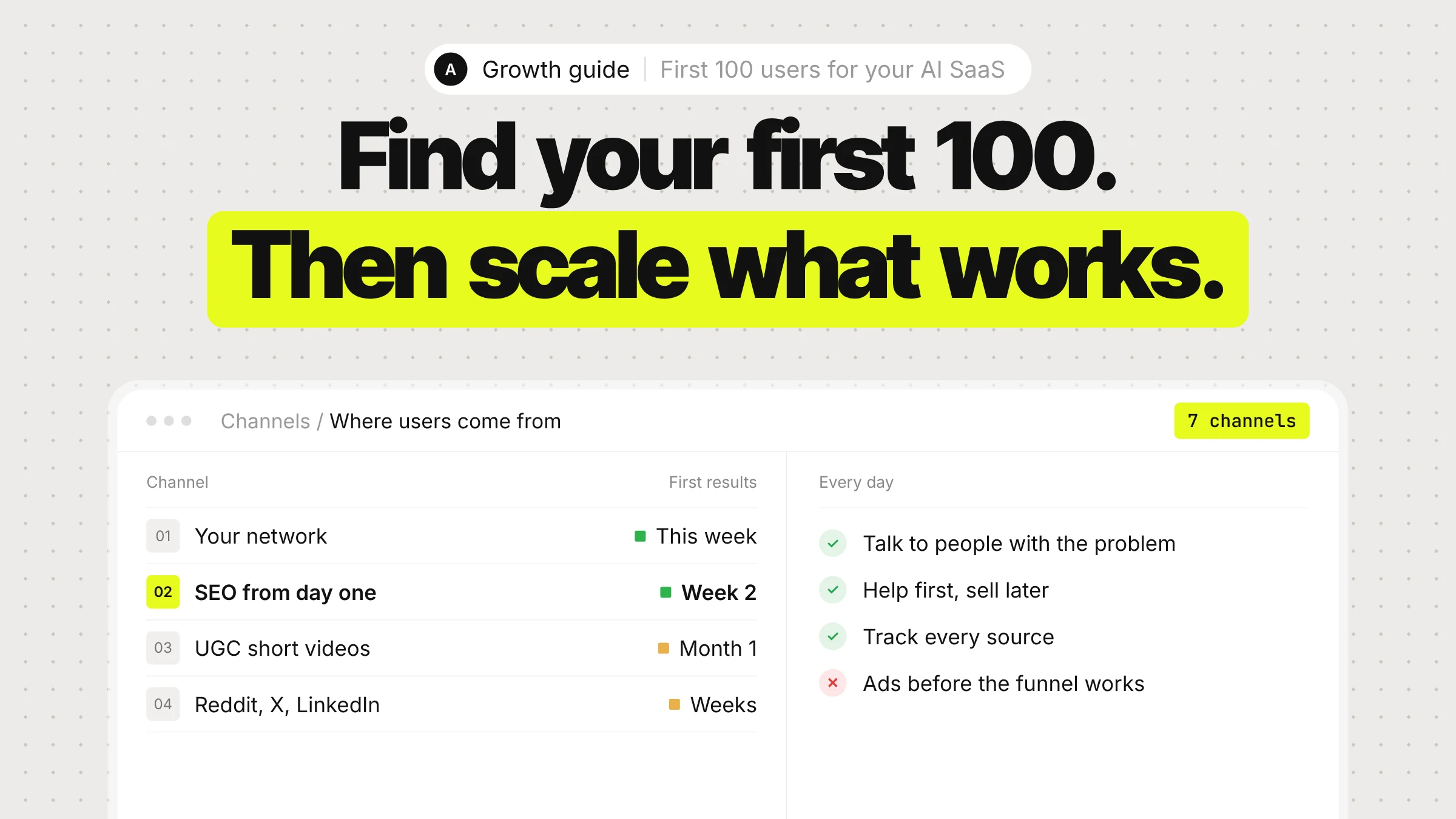
Getting the first 100 users for your AI SaaS is hard, and nobody does it with one big launch. You do it by working several channels at once, every day: asking your network, starting SEO on day one, posting short videos, showing up where your users already talk, launching on Product Hunt, and measuring all of it from the first visitor. Paid ads come last, once you know the funnel works.
This guide goes through those seven channels in the order we use them with founders, with current data for each one. It is the growth half of our build guides: if you are still building, start with what belongs in an AI MVP and how to start an AI SaaS in Claude Code.
The short answer
| Channel | Best for | When you can expect results |
|---|---|---|
| 1. Your network | Everyone | This week: 2 or 3 people who will try it |
| 2. SEO from day one | B2B and B2C | First visitors in week two, first paying customers in month two |
| 3. UGC short videos | B2C | Most early videos flop; good results after about a month of posting |
| 4. Reddit, X and LinkedIn | B2C, developers, B2B | Weeks, if you help first and sell later |
| 5. Product Hunt and other launchpads | Tools for makers, developers, early adopters | One spike of traffic and feedback |
| 6. Analytics | Everyone, from the first visitor | Immediately: it tells you which of the above works |
| 7. Paid ads | After the funnel works | Fast, but only worth it once activation is proven |
1. Ask your network
Start with people you already know. In most cases you can find two or three people who are interested enough to try your app this week: a former colleague with the problem, a friend in the industry, someone from a founder chat you are in. That doesn't sound like much, but your first three users are worth more than your next thirty, because they will actually tell you what is broken.
It is also how most of today's big companies started. When Lenny Rachitsky looked at how 23 of the fastest growing B2B companies found their first ten customers, roughly half of them started with the founders' own network, including Slack, Stripe, Gusto, Carta and Intercom. In his study of consumer apps, Yelp, Facebook, LinkedIn and Pinterest seeded their first users the same way, and Yelp got to roughly 1,000 users just from invites two degrees out.
There is a simple reason it works. People trust people. In Nielsen's US Trust in Advertising study, 89% of people said recommendations from people they know are the advertising they trust most, ahead of every paid channel.
How to do it well:
- Ask for a 15-minute call, not a signup. Watch them use the app. You will learn more in one call than from a week of analytics.
- Ask who else has the problem. Every good conversation should end with one or two introductions.
- Write down the exact words they use to describe the problem. You will reuse them in your landing page, your SEO and your videos.
2. Start SEO from day one
SEO is a long game, and that is exactly why you should start it on day one, not after launch.
There is a new reason too. A lot of good traffic now comes from AI chatbots: ChatGPT has 900 million weekly users and Google's AI Mode passed 1 billion monthly users. But these tools need to learn about you first, and they learn mostly from search. When ChatGPT looks something up, its sources line up more and more with Google's: Profound measured ChatGPT's citations matching Google results rising from 12% to 33% in just three months, while its overlap with Bing fell. So by doing SEO you are building a foundation that works for both Google and the chatbots, and it only grows over time.
The numbers on AI traffic are small but growing fast, and the visitors are good ones:
- Across 101,574 websites, SE Ranking found traffic from AI search grew 16x from 2024 to 2026, with ChatGPT sending about 75% of it.
- Demandbase saw ChatGPT referrals to B2B websites grow 303% in a year, from about 645,000 to 2.6 million visits a month.
- At Ahrefs, AI search sent just 0.5% of visitors but 12.1% of signups. Those visitors converted 23 times better than regular organic search, because they arrive already convinced.
- For B2B, Gartner found 45% of buyers used generative AI during a recent purchase, mostly to research vendors and products.
Why start early? Because Google rewards age and consistency. In Ahrefs' latest study, 72.9% of pages in Google's top 10 are more than three years old, and only a few percent of new pages reach the top 10 within a year. Most of the pages that do get there do it fast, though: about 40% of them get there within a month. That is the pattern we see with new products. If you pick the right keywords (specific, low competition, with clear intent), you can expect your first visitors in the second week and your first paying customers from search in the second month.
What to do in the first month:
- Pick 10 to 20 long-tail keywords your users actually search, like "AI tool for [their task]" or "[competitor] alternative". Use their words from step 1.
- Publish one useful page a week: a guide, a comparison, an alternatives page, a free tool. Each one is a new door into your product.
- Fix the technical basics: a sitemap, fast pages, clear titles, structured data, and pages that load without JavaScript so crawlers and AI bots can read them.
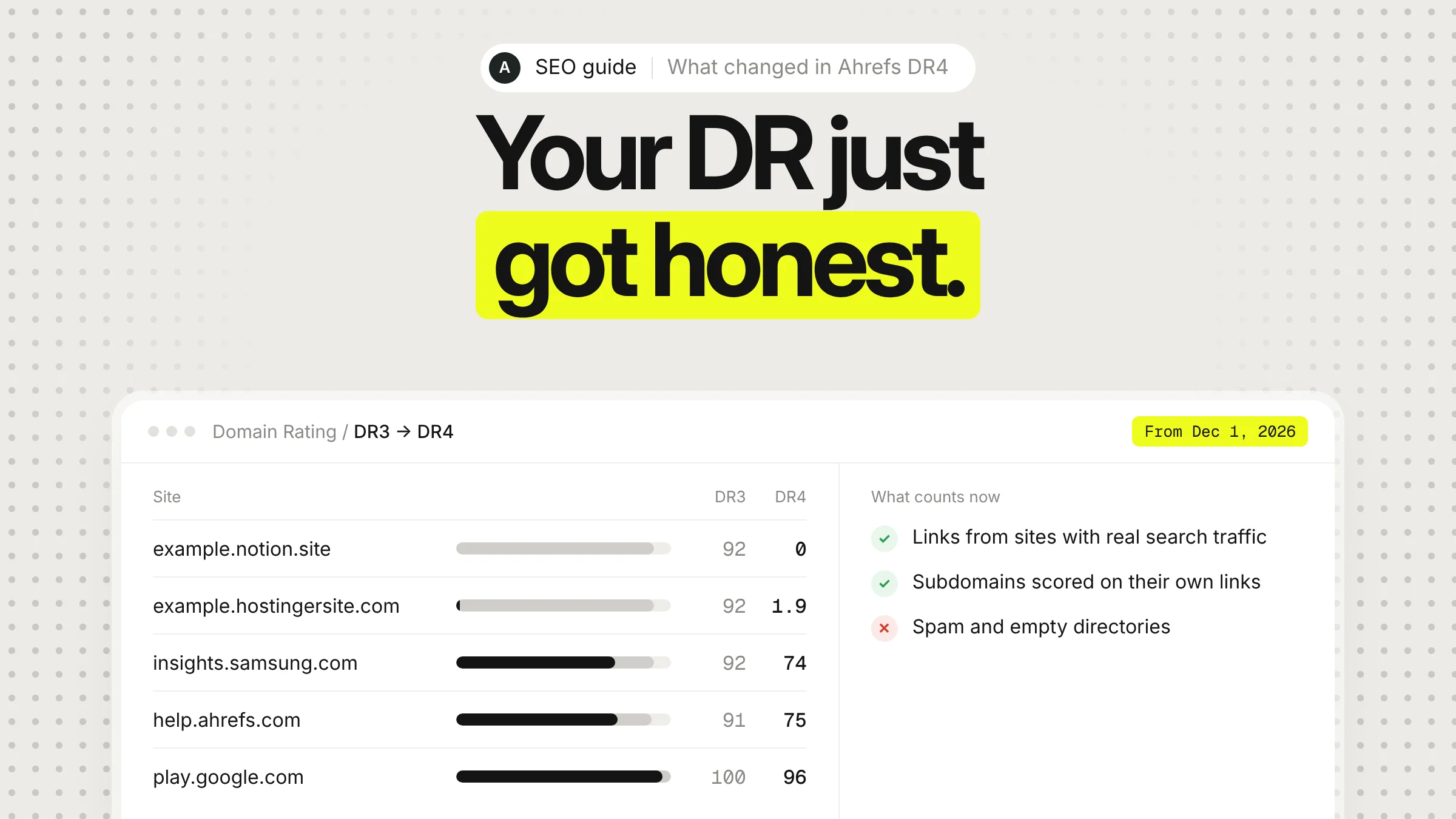
- Earn a few real links. If you are new to this, our guide to what changed in Ahrefs DR4 explains which backlinks still count and which are a waste of money.
3. UGC short videos (for B2C)
If you are building for consumers, the best place to grow right now is short UGC content on Instagram and TikTok. That is where the attention is: Instagram has more than 3 billion monthly users, and more than half of the time on it now goes to Reels.
It also converts. In a TikTok and Deloitte study, 75% of users found creator content more trustworthy than traditional advertising, 65% said they had bought something they discovered on the platform by accident, and 43% of Gen Z start looking for products on TikTok.
You don't need an agency or a studio to start. Create the videos yourself and experiment with the format until you find what works: a quick demo, a before and after, "I tried to do X with AI", a reaction to a common complaint in your niche. Film on your phone, keep it under 30 seconds, and put the hook in the first two seconds.
The key here is consistency. Your first video will probably fail. So will the second. That is normal, because each one teaches you something about the hook, the length and the topic. Post every day or close to it, keep the formats that get watched, drop the rest, and in a month you can expect good results.
4. Reddit, X and LinkedIn
Every social platform has its own type of people:
- B2B: LinkedIn. It has more than 1 billion members, including 65 million decision makers, and the Content Marketing Institute found 76% of B2B marketers call it an effective channel for thought leadership.
- Developers: X (Twitter). It is where developer tools get shared, debated and launched, and where building in public works best. Developers live on Reddit too: 53.7% of developers in Stack Overflow's 2025 survey of 49,000 use it.
- B2C: Reddit. It now has 130 million daily and 515 million weekly users, organized by exactly the interests and problems you are looking for.
There is a bonus: AI learns a lot from these platforms. In Peec's analysis of 30 million sources cited by AI search engines, Reddit was the most cited domain, YouTube second and LinkedIn third. When ChatGPT searches a specific site, 71% of the time that site is Reddit. A helpful Reddit thread about your product can show up in AI answers for months.
Every platform is a bit tricky to grow on, and each has its own rules. The main takeaway is the same everywhere: find where your users spend time and go there. Talk to them. Look for people who have the problem you are solving, and be helpful. Answer the question, share what you learned, and don't try to sell immediately. Communities spot a sales pitch fast, and on Reddit it can get you banned. When you have helped enough people, they will ask what you are building.
5. Launchpads like Product Hunt
Product Hunt still works, especially for AI products. In Q2 2026 it had 2,345 launches, up from 1,508 a year before, and AI launches averaged 252 upvotes against 190 for all launches. Loom got its first roughly 3,000 users from Product Hunt.
Be realistic about it, though. A launch is one day of traffic, not a growth channel. Competition is much higher than it used to be, and by several 2025 analyses only about 1 in 10 launches now gets featured on the homepage. Featured launches typically get 1,000 to 5,000 visitors that day, and the rest a few hundred.
To make it count:
- Launch after you have your first users, not before. You want reviews and comments from real people on launch day.
- Prepare the page: a clear tagline, a short demo video, and a free trial or free tier so visitors can try it right away.
- Use the spike. Reply to every comment, email everyone who signs up, and ask them what they expected.
- Don't stop at Product Hunt. Hacker News (Show HN), Indie Hackers, BetaList and niche directories in your category work the same way and add backlinks for your SEO.
6. Turn on analytics from day one
Analytics is not a channel, but without it you can't tell which channel works. Turn it on before your first visitor, not after.
Good analytics helps you analyze your first traffic and see where it breaks: people visit and leave, people sign up and never come back, people start the trial and don't pay. Most important, it shows you how the channels compare: where traffic comes from, which source converts better, and what you need to fix.
You don't need anything expensive. PostHog, for example, gives you 1 million events and 5,000 session recordings a month for free. Set up:
- Traffic by source, with UTM tags on every link you share, so you know if a signup came from Reddit, a video or Google.
- One activation event: the moment a user gets real value, like their first generated result or their first finished task.
- A funnel from visit to signup to activation to payment.
- Session recordings, so you can watch where people get stuck.
Then compare yourself to benchmarks. In Lenny's data, the median activation rate for SaaS is 30%. For free-to-paid conversion, 3 to 5% is good for a freemium product and 8 to 12% is good for a free trial. If you are far below, fix the product and onboarding before you spend money on more traffic.
7. Paid ads (Google, Meta), but later
We usually don't start with paid ads, and here is why. Ads are a multiplier. If your funnel is broken, they multiply the problem, and you pay for every visitor who leaves.
It is not cheap either. The average Google Ads click now costs $5.42, and the average lead $66.69. Acquisition costs have been climbing for years: one study estimated they rose as much as 60% in five years.
It is always better to start with some small, free traffic from the channels above and test how your app works with it. See where things don't work and what users tell you about it. Fix it, and make sure the funnel all the way to activation works. When you have the numbers that tell you everything is OK (people sign up, activate and pay at healthy rates), you can scale with ads, and every dollar works harder.
What ties it all together
There is no shortcut here. Getting your first 100 users means doing all of this, every day. Talk about your app. Talk with the people who have the problem. Be an expert in your field, by writing, posting and answering questions, so people trust you. That is the key: people buy from someone they trust, and early on, that someone is you.
Your goal at this stage is not 100 users for the sake of the number. It is to find a traffic source that scales and to find product-market fit. A simple way to check fit is the Sean Ellis test: ask your users how they would feel if they could no longer use your product. If 40% or more say "very disappointed", you are on the right track. If not, keep talking to users and keep fixing before you scale.
Once you have found a traffic source that works, the next problem is retention and churn. That is a different article.
How Anivia Labs can help
Doing all seven of these while also building the product is a lot for one founder. That is what our Growth service is for. One senior team handles positioning, SEO and content, short videos with UGC creators, LinkedIn and community work, outbound, launch videos, Product Hunt launches and analytics, and the same team builds the landing pages and tools behind them. It is part of one monthly subscription, with a 3-day free trial.
If you are still at the build stage, our MVP development gets you from idea to a product people pay for, with analytics and SEO set up from the first day. For search on its own, see our SEO service.
FAQ
How long does it take to get the first 100 users for a SaaS?
For most early AI SaaS products, two to four months of daily work across several channels. The first handful come from your network in the first week, SEO starts bringing visitors in week two, and short videos and communities usually start working after about a month of consistent posting.
What is the best channel for the first users of an AI SaaS?
Your own network first, because it is fast and the feedback is honest. After that it depends on who you sell to: LinkedIn for B2B, X and Reddit for developers, and short UGC videos on TikTok and Instagram plus Reddit for B2C. SEO is worth starting for everyone on day one.
Should I launch on Product Hunt first?
No. Launch after you have some real users and have fixed the obvious problems. A launch gives you one day of attention, so you want a product that turns that attention into users.
When should I start paid ads?
When analytics shows your funnel works: people from free channels sign up, reach the activation moment and pay at healthy rates. Before that, ads mostly pay for people to find your bugs.
Does SEO still matter now that people use ChatGPT?
More than before. AI assistants rely heavily on search results to find and cite sources, and AI search visitors tend to convert much better than regular search visitors. SEO is how you show up in both.
What comes after the first 100 users?
Retention. Once you know where users come from, the next job is making sure they stay. We will cover retention and churn in a separate guide.