
The best design engineering agencies in 2026 are the ones where the people who design your product also build it. Our pick of eight: basement.studio for brand sites and launches with serious craft, Anivia Labs for startups that need product, growth and data work from the same team that ships the code, Metalab for large product design programs, thoughtbot for design plus long-lived Ruby on Rails engineering, 14islands for creative technology and 3D, Instrument for big-brand campaigns and digital products, Ramotion for brand-to-website projects, and Halo Lab for design and Webflow builds at a lower hourly rate.
We are one of the eight, so we have tried to be specific about where each of the others is the better choice. Every fact below about another agency is linked to its own site or a public profile.
Why design engineering matters now
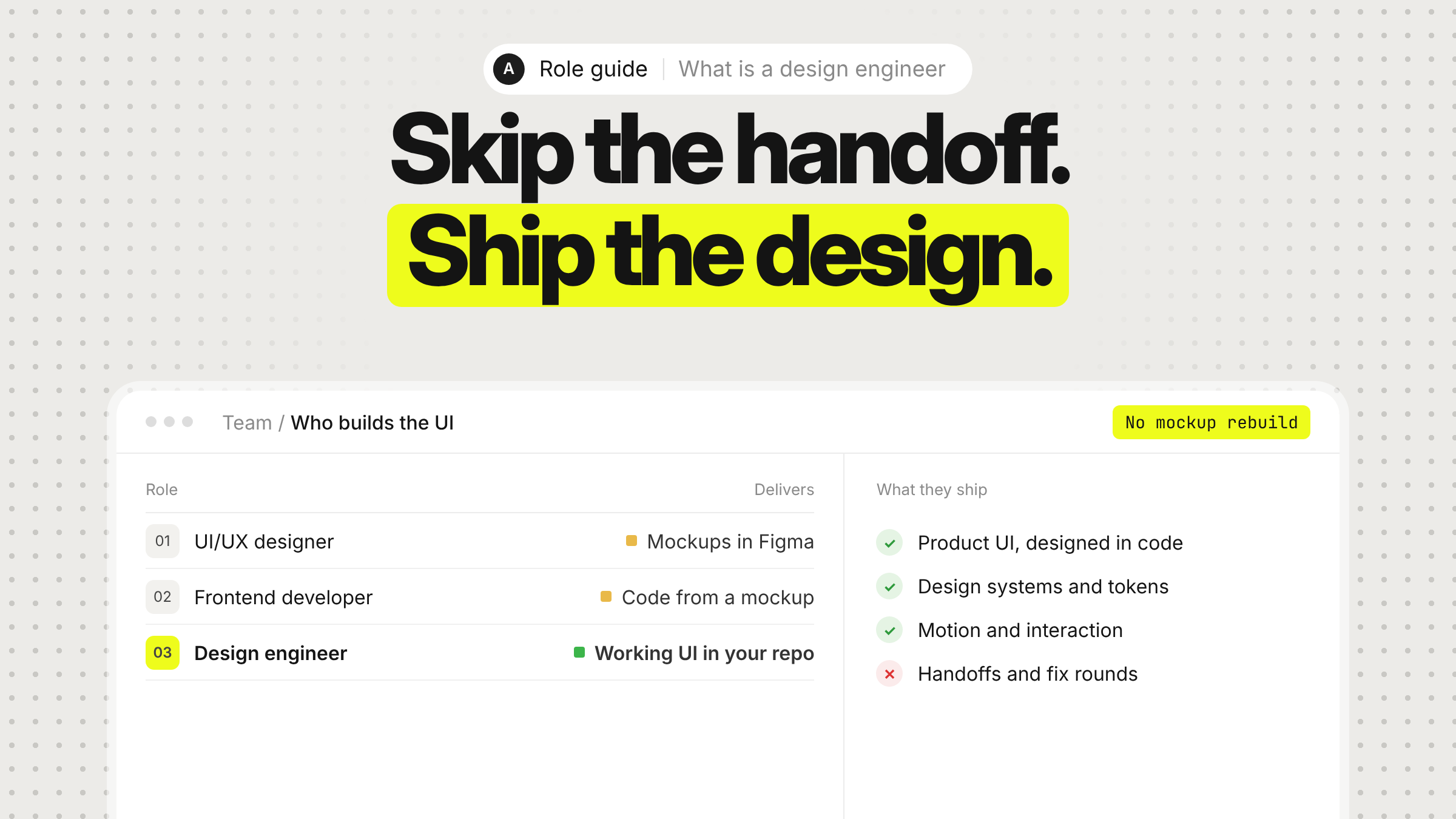
Design engineering is design and development done by the same people. A design engineer makes the calls on layout, type, interaction and motion, and then ships them as production code, usually in React and Next.js, instead of handing a mockup to someone else to rebuild. (If you want the long version of the role, read What Is a Design Engineer?.)
It matters for three reasons.
1. The handoff is where products lose quality. The classic chain is mockup, handoff, rebuild, design QA and fix rounds. Every step loses something: spacing, empty states, the hover nobody drew. When the person who designs the screen ships it, that chain becomes two steps: brief, then live code.
2. Integrated teams make more money. McKinsey followed 300 public companies for five years and found that the top quartile on design had 32 percentage points higher revenue growth and 56 points higher shareholder returns than their industry peers. One of the strongest links to performance was the ability to "break down functional silos" and put designers to work alongside other functions (McKinsey, The Business Value of Design). Design engineering is that idea taken to its end: no silo between design and code at all.
3. AI rewards whoever works in code. In Figma's 2025 AI report, 59% of developers used AI for core work against 31% of designers (Figma, 2025). A designer whose output is a static frame gets less from AI tools than someone whose output is code. Teams that design in code can move at the speed AI now allows. Teams that design in files still wait on a rebuild.
That last point also changes what you should expect from an agency. Shipping beautiful UI is now the baseline. The better question is what that UI does for your numbers: signups, activation, retention and revenue. That is the lens we used for this list.
How we picked
We looked for agencies that:
- Design and build in-house. Design and engineering on one team, not a design studio that subcontracts development.
- Have public, checkable work. Named clients and live products, not only Dribbble shots.
- Are active in 2026. Agencies that were acquired and folded into larger groups are left out.
- Fit a specific buyer. No agency is best for everyone, so each one comes with a "choose it if" and a "skip it if".
The short answer
| # | Agency | Based in | How you pay | Best for |
|---|---|---|---|---|
| 1 | basement.studio | Mar del Plata, Argentina | Project, quote on request | Launch sites, brand and 3D web for tech companies |
| 2 | Anivia Labs | Kyiv and Dubai | Monthly subscription from $1,690, 3-day free trial | Startups that need design, code, growth and data in one team |
| 3 | Metalab | Victoria, Canada | Project, quote on request | Large product design and build programs |
| 4 | thoughtbot | New York and London | Hourly, about $150 to $199/hr, $10,000+ projects | Design plus long-term Rails and web engineering |
| 5 | 14islands | Stockholm and Reykjavík | Project, quote on request | Creative technology, WebGL and brand experiences |
| 6 | Instrument | United States | Project, quote on request | Brand, product and campaigns for large brands |
| 7 | Ramotion | San Francisco | Project, about $150/hr | Brand identity through to the website |
| 8 | Halo Lab | Dubai, founded in Odesa | Hourly, $25 to $49/hr, $10,000+ projects | Design and Webflow builds on a tighter budget |
Rates come from each agency's site or its public Clutch or DesignRush profile, read in November 2026. Agencies change rates often, so confirm before you sign.
The best design engineering agencies in detail
1. basement.studio
basement.studio is a design and engineering studio founded in 2020 and based in Mar del Plata, Argentina, working mostly with technology companies in the US. Its own FAQ puts the model plainly: "Design and engineering live in the same team," and the studio "builds primarily with Next.js and modern web tooling," with depth in WebGL, GSAP animation and performance (basement.studio FAQ).
The client list is as strong as it gets for a studio this size: Vercel, Next.js, Linear, Cursor, Scale AI, ElevenLabs and others, and the studio is behind the Geist typeface made with Vercel (basement.studio). It is also a Vercel solution partner.
Choose it if you are a funded tech company with a launch, a rebrand or a flagship site that has to look and feel like nothing else on the web.
Skip it if you need ongoing product, growth or marketing work after the launch. basement is built around brand and web experiences, and it does not publish prices.
2. Anivia Labs
Anivia Labs is a design engineering subscription for startups, from the team behind DESH, a design and development agency from Kyiv with 100+ shipped projects and a 5.0 rating on Clutch. We are on this list because we think design engineering should be judged by what it does for the business, not only by how it looks.
What makes us different from a design studio:
- Product, not just screens. A senior design engineer designs in code and ships React, Next.js and TypeScript to your repo as pull requests. On the All-in-one plan the same queue covers backend, mobile and AI features, so a product change does not wait on a second vendor.
- Growth in the same team. Through our growth and SEO work we run go-to-market, inbound and outbound, social, UGC and launch videos, and build the landing pages behind them. The person who designs the page also knows the funnel it sits in.
- Decisions from data. We set up analytics on the funnel (PostHog, GA4, Search Console), find the step that leaks, redesign it and measure again, so a design change shows up as a number.
- Plugged into your AI tools. You can send tasks straight from Claude Code, Codex or Cursor through our MCP server, and we ship a design system your AI agents can follow (more on how that works).
The results look like growth, not portfolio shots. For an AI render studio we took the product from zero to first revenue in 3 weeks, grew organic Google clicks 50x in 3 months, and lifted visitor-to-signup from 8% to 20% (Rendervi case study).
Pricing is public: $1,690 a month for Design Engineering, $2,490 a month for All-in-one with development and growth, and a Dedicated Team plan for bigger roadmaps. Monthly billing, pause or cancel anytime, and a 3-day free trial before you pay (pricing).
Choose us if you are a startup or scale-up that needs product design, working code and growth from one senior team, and you care about signups and revenue as much as pixels.
Skip us if you need a one-off award-site launch with heavy 3D for a big brand moment. basement.studio or 14islands are built for exactly that.
3. Metalab
Metalab is an interface design firm founded in 2006 by Andrew Wilkinson and headquartered in Victoria, British Columbia. It covers product strategy, UX and UI, brand, and software engineering. Its best-known work includes Slack, and clients include Uber, Coinbase, Headspace and Amazon. Since 2017 it has been part of Tiny, a Canadian holding company, while operating independently (Wikipedia).
Choose it if you are a well-funded company with a big product to design and build, and want a team with one of the strongest product design track records around.
Skip it if you are early stage or want monthly flexibility. Metalab works on scoped projects, does not publish prices, and is priced for companies that have already raised.
4. thoughtbot
thoughtbot has combined product design and development since 2003, with offices in New York and London and 50 to 249 people. Its Clutch profile lists a $10,000 minimum project and $150 to $199 an hour, with a 4.9 rating (Clutch). Clients include GitHub, Vimeo, Etsy and Autodesk (DesignRush). Developers know it for open source: factory_bot, Clearance and Paperclip all came from thoughtbot (thoughtbot blog).
Choose it if you have a Ruby on Rails product, or want an engineering-first partner that will also train your team and leave clean code behind.
Skip it if visual brand and marketing craft are the priority. thoughtbot's strength is the product and the codebase.
5. 14islands
14islands is a design and technology studio with offices in Stockholm and Reykjavík that describes itself as "a nimble team designing and building digital products, brands, and experiences." Its development work spans front-end, WebGL and 3D, XR and agentic AI interfaces, and clients include Spotify, Google, Cartier, Adidas, Disney and Shopify (14islands).
Choose it if you want a brand experience with real creative technology: 3D, motion and interactive pieces people remember.
Skip it if you need product iteration week after week. 14islands is strongest on branded experiences and scoped projects.
6. Instrument
Instrument calls itself "a technology-led brand, product, & marketing agency" that designs "across brand, product, and marketing." Selected clients include Nike, Google, Oura, Netflix, Spotify, Stripe and Microsoft (Instrument).
Choose it if you are a large brand that needs brand, digital product and campaign work under one roof.
Skip it if you are a startup. Instrument's model, client list and pricing are built around enterprise budgets.
7. Ramotion
Ramotion is a San Francisco agency founded in 2011 with 50 to 99 people across branding, UI/UX, web and mobile development. Listed clients include Adobe, Netflix, Salesforce, Mozilla and Okta, at an average of about $150 an hour (DesignRush).
Choose it if you need a new brand identity and a website built on it, from one agency, on a fixed project.
Skip it if you need ongoing product engineering or growth work. Ramotion's center of gravity is brand and web.
8. Halo Lab
Halo Lab was founded in Odesa in 2013 and now has its headquarters in Dubai, with a team of about 150. It covers UX/UI, branding, web and app development, and low-code builds in Webflow. Its Clutch profile lists a $10,000 minimum and $25 to $49 an hour, with a 4.9 rating across 100 reviews (Clutch).
Choose it if you want a marketing site designed and built in Webflow at a lower hourly rate than US agencies.
Skip it if your product runs on a custom React or Next.js codebase and you want design shipped straight into it.
How to choose a design engineering agency
Start with what you need to change. If it is a launch moment, pick a studio built for brand and web craft (basement.studio, 14islands). If it is your product and the numbers behind it, pick a team that ships code and owns outcomes (Anivia Labs, Metalab, thoughtbot).
Ask who writes the code. "Design and development" on a website can mean a design studio with a freelance developer. Ask whether the people who design the screens open the pull requests.
Ask how they measure success. A strong answer names a metric: signup rate, activation, organic traffic, revenue. A weak answer names deliverables: screens, pages, files.
Match the pricing model to your stage. Project agencies suit a defined scope and a fixed budget. A subscription suits startups whose priorities change every few weeks, because you can redirect the work without a new contract.
Check the stack. If your product runs on React and Next.js, the agency should ship into that repo, through reviewed pull requests, not hand over a separate codebase.
FAQ
What is a design engineering agency?
An agency where the same people design and build the product. Instead of handing a Figma file to a separate development team, design engineers make the design decisions and ship them as production code, usually in React and Next.js.
How is design engineering different from a UI/UX agency?
A UI/UX agency delivers designs, usually in Figma, that someone else has to build. A design engineering agency delivers working software, so nothing gets lost between the mockup and the product.
How much does a design engineering agency cost?
It depends on the model. Project agencies in this list charge from about $25 to $199 an hour, with minimums from $10,000, and many quote only on request. A subscription like Anivia Labs starts at $1,690 a month, with a 3-day free trial.
Is a design engineering agency right for an early-stage startup?
Usually yes, if it can also help with growth. Early on you need a product that works, a landing page that converts and a way to see what users do. One team that covers all three moves faster than a design studio, a development shop and a marketing agency working in sequence.