Far more AI prototypes are built than are ever brought to production. Most teams struggle to move from a compelling demo of a working prototype to building a system that handles real traffic, deals with dirty input data, and can operate within the constraints of production. AI MVP development services help to bridge this gap by allowing a hypothesis to be translated into the minimum viable product required to get feedback from real users. In terms of a discipline, this form of work is similar to lean product development, but with an AI twist. While the typical software MVP fails fast on the basis of various feature assumptions, an AI MVP can fail on the basis of data assumptions, latency, and various confidence threshold assumptions that only surface when the MVP is put into production.
As opposed to a traditional software MVP, which fails fast based on the assumptions you made about the features, an AI MVP fails based on entirely different sets of assumptions: data, performance, or confidence threshold-related. The sections below detail how to scope, build and launch an AI product that moves past the demo phase, laying out the key decisions that allow teams to go from prototype to GA, and realizing value along the way.
Why Most AI Prototypes Never Become Products
MVP development for an AI product creates the smallest possible working product around one AI capability. It thus simultaneously proves user value and model value on real data, i.e. in scenarios most prototypes never reach.
The Demo-to-Production Gap Is Wider for AI Than for Traditional Software
Just as a model scoring 90% in your notebook is NOT a product, so too, a AI build (of any sort) is not a product until it hits a number of key boundaries around inference latency, data drift, and a variety of edge cases that surface only when stress-tested by real users.
Three Failure Modes: Scope Creep, Model Dependency, and Missing Feedback Loops
Teams that set out to build AI product often encounter three primary failure modes: 1) Scope is not contained to test a hypothesis and instead is continuously expanded to hit the benchmark; 2) The hard coupling to a single vendor with no real fallback; 3) No way to log real user outputs for retraining.
What Separates a Shipped AI MVP from a Permanent Proof-of-Concept
The gap between AI prototype to production is bridged by three concrete properties: 1) a defined boundary for inference, 2) observable outputs, and 3) a plan for a roll back. Treating your prototype as a hypothesis test for what gets to form the core of your AI product rather than a foundation to add more features to keeps the scope of your AI MVP in check.
Scoping Your AI MVP: The One-Hypothesis Rule
Instead of products sinking due to problems with their AI models, many AI products fail due to scope failures. Defining a tight AI MVP scope prior to any coding, written down and reviewed by the whole team before any code is committed, keeps everyone aligned on what shipped means.
How to Write a Falsifiable AI Product Hypothesis in One Sentence
An AI product hypothesis has the same structure to a hypothesis for a non-AI product: "AI can reduce [something related to a task] by [a number] % for [a user or user group]. Measured by [a measure]." That's a hypothesis to ship AI MVP (a version of) a product. The same structure to state a hypothesis to ship a product applies to an AI product. Without all three components, you have no ship/no-ship signal with your team.
Choosing the Single Workflow AI Will Touch First
At first, refrain from automating the entire workflow in v1 and instead start with the one step in the workflow where verifying the output quality created by humans is easiest. This step then becomes the beachhead for the team, as shown in this voice AI agent scoping example.
Defining Done: Output Quality Thresholds Before You Write a Line of Code
Establishing thresholds beforehand (e.g. <5% hallucination on structured output, >80% user acceptance on generated suggestions) enables you to decide between prompt engineering, RAG, or a fine-tuned model.
Choosing the Right AI Stack for an MVP (Without Over-Engineering It)
Hasty and ambitious stack decisions are some of the worst things that can happen to a promising build. The simplest AI MVP stack is the one that proves your hypothesis.
Pre-trained APIs vs. Fine-tuned models: the MVP default decision tree
A common starting point for early builds are to start with a pre-trained model (e.g. from OpenAI, Anthropic, Gemini) and very strict prompt engineering. Fine-tuning is usually only considered after 500+ labeled examples of production failures have been accumulated (which rarely happens before a product is launched). Abstracting out model routing using tools like LiteLLM makes it easy to switch between different model providers.
When RAG is the right call over a custom model
Rather than considering RAG vs. fine-tuning for your product, ask yourself whether the core value proposition of your product relies on proprietary or frequently updated knowledge. If so, retrieval is typically the better approach, with more detail on when each is appropriate in this model adaptation comparison.
Infrastructure choices that won't trap you at scale
An MVP based on a LangChain setup paired with a hosted orchestration system (like Weaviate Cloud or Pinecone) has the benefit of moving fast and not having to worry about the operational overhead of a managed vector store compared to rolling one's own. A no-code AI product is fine for investor demos, but will hit a logic ceiling very quickly, so it's wise to plan for the migration point before it's actually reached.
The AI MVP Development Process: From Week One to Ship
A disciplined AI product development process prevents the biggest pain point of product builds that sprint into model work without first confirming that they have the necessary data and a testable hypothesis to begin building.
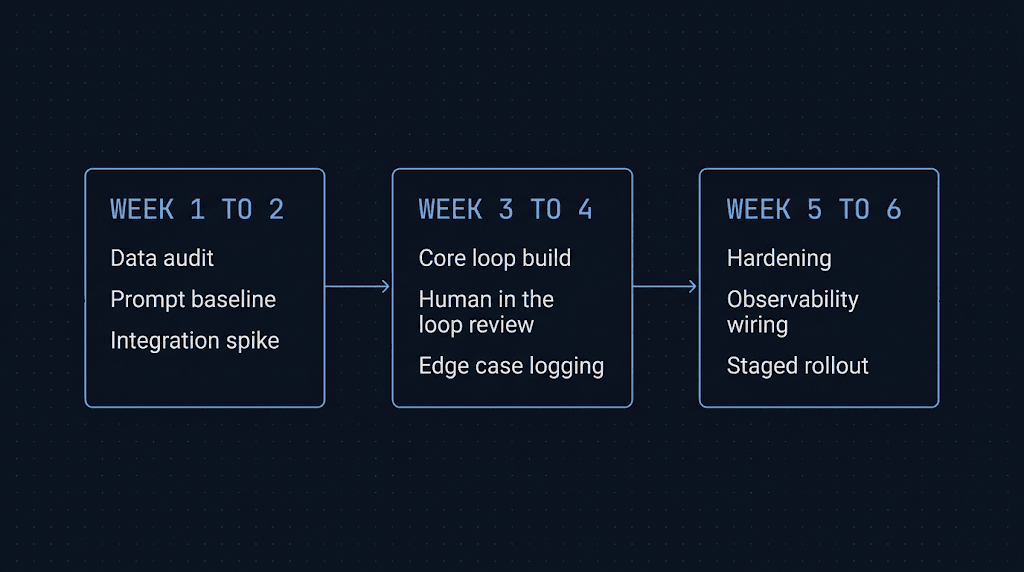
Week 1 to 2: Data Audit, Prompt Baseline, and Integration Spike
Week 1 is audit the data you have. Get an understanding of what data you have, in what format it exists in, and whether or not it is sufficient to test your hypothesis. A missing data audit is typically the largest cause of timeline blowouts on a AI product build.
Week 3 to 4: Core Loop Build, Human in the Loop Review, and Edge Case Logging
Your core loop is the minimal path to get user input through AI inference and back to user action via displayed output. Human in the loop review on this stage of development is not a temporary crutch but rather each correction made by the reviewer is another labeled example for future development. Instead of fixing Edge Cases immediately they get logged.
Week 5 to 6: Hardening, Observability Wiring, and Staged Rollout
It's important to include observability for safely shipping AI-based MVP features early. This means logging all prompts, all responses, all latency measurements and all signals of user acceptance from the very first use. A staged rollout from 5% to 25% to 100% of users with a feature flag is also important to catch any regressions of the model before they affect all users.
Data Strategy for AI MVPs: What You Actually Need on Day One
A sound data strategy for your MVP is more important than choosing the right AI model for early-stage work. The data you collect, log and act upon within the first weeks of your founder journey will set the stage for improvement or stagnation.
Minimum Viable Data: How Much Is Enough to Start?
But most teams overestimate the amount of data they need to get started with prompt-based AI. Having 20-50 high-quality examples for a structured output task is sufficient to get a working baseline up and running. Waiting for a clean and comprehensive data set for your prototype is prototype-stage behavior.
Synthetic Data and Few-Shot Prompting as Bootstrapping Tools
Few-shot prompting and generating synthetic data for structured output tasks like classification can serve as a starting point. Be aware though that generated training examples are only of value if you can very quickly validate them against real user behavior, otherwise they just end up accumulating errors instead of solving problems.
Building a Feedback Flywheel from Your First 100 Users
An AI feedback loop is often one of the most durable data assets you will produce as a product. A single thumbs-down, an edited output, or a re-generation request is labeled signal. It is best to capture all these interactions early in the design of your UI before it gets too late and the volume of interaction becomes too expensive to retrofit.
Prompt Engineering, RAG, and Fine-Tuning: Picking the Right Lever at MVP Stage
The biggest cause of over-engineering of early MVPs, relating to model adaptation, is picking the wrong technique and spending months of work before shipping, to find out that scope has changed by then.
Prompt Engineering: The Fastest Path to a Working Baseline
Prompt Engineering should always be your very first step to troubleshooting Output Quality issues before even considering RAG, let alone Fine-tuning. As no additional infrastructure, no additional labeled data is required and all changes are immediately and completely reversible, there is no reason not to exhaustively test structured system prompts with few-shot examples for early-stage builds. They will solve the vast majority of issues encountered with regards to Output Quality already before having to even think of Fine-tuning.
RAG: When Your Product's Value Lives in Proprietary Context
A RAG pipeline is an MVP that makes sense if your answers need to be grounded in some specific, updatable corpus (e.g. your internal docs, product catalogs, contracts with lawyers). While Retrieval adds latency and requires a bunch of extra infrastructure, if the corpus in question changes frequently and you're worried about your AI just making stuff up about domain facts that end up causing real product risk, then a RAG pipeline makes sense.
Fine-Tuning: The Post-MVP Optimization, Not the Starting Point
The key points are that fine-tuning is a form of optimization to be done after you have got production up and running, and the only circumstance where prompting won't fix certain errors is if there is a consistent failure pattern, and you have 500 or so labeled correction examples for that failure case.
From AI MVP to Production: The Hardening Checklist
An AI prototype should not move to production without a serious discussion about safety, speed and stability for real users.
Guardrails and Output Validation Before Any User Sees a Response
There are three types of guardrails for AI products: schema validation for structured output; content filter for user generated text; and a fallback response for low confidence generation. A model generating malformed JSON or off topic completion is not a model problem, it's a problem of a missing contract between the layer doing the inference and the rest of the application. It's a problem that needs to be caught at scoping not at incident time.
Latency, Reliability, and Graceful Degradation Patterns
The user expect AI powered features to respond within 3 seconds, the perceived latency can be 'reduced' by streaming responses and using optimistic UI patterns. It's also important to have a non-AI fallback path for the AI model API.
Evaluation Pipelines: How to Know Your Model Is Not Regressing
An AI evaluation pipeline, a versioned set of golden test cases for AI evaluation that are run on every deployment, is what will enable you to ship AI-powered prompt updates to your users with confidence. Note that treating Production readiness as a final Phase in your AI MVP development will only end up costing you 2 to 3 times as much for hardening as if you had planned for it at Scoping.
Your AI MVP Launch Checklist: Ship It, Then Improve It
Shipping early, before the entire product is ready, is the right call. Shipping without the infrastructure to learn from failures is the mistake.
What Must Be in Place Before Real Users Arrive
Before the system reaches real users, the team needs observability into what the system is doing, the ability to roll back changes, tested output guardrails, one real task the system completes end to end, and a single metric that determines whether to continue or pivot.
How to Structure the First Post-Launch Sprint
The first two weeks after an AI MVP launch are spent with logged failure cases as opposed to new features. Customers will break your product in ways you never thought of with your internal test cases and fixing those cases yields more signal than a roadmap of new features.
Signals That Tell You the Hypothesis Was Right or Wrong
A validated hypothesis (higher than planned levels of target metrics and retention for AI features) can always be 'unvalidated' at relatively low cost. It's far worse to spend a quarter adding more complexity to fail with your new AI powered functionality to rescue a hypothesis that was wrong anyway.
Conclusion
The most important discipline to master for shipping working AI products is keeping scope focused enough to validate model behavior with real user data before complexity explodes. The most avoidable failure mode in AI MVP development services is to keep adding more features to the feature surface before you validate the core hypothesis for that particular feature. All the decisions around stack, data, and production-hardening follow from that single constraint. Founders and CTOs moving from a validated concept to a shipped product can treat this build cycle as a working checklist, revisiting architecture and model tradeoffs only once real usage data is available to guide them. Teams weighing outside engineering support at this stage can review what AI MVP development work involves.
FAQ
How long does AI MVP development typically take from idea to launch?
Shipping a focused AI MVP in 6-12 weeks is very realistic, as long as one focuses on a single hypothesis to test. The biggest influence on time needed to ship an AI MVP is trying to validate too many use cases, over-engineering the stack and waiting for "perfect" training data. To ship as fast as possible, a team should treat the first week to discover requirements and set up an architecture, the following 5 weeks to build the core of the product, and then use the remaining time to harden the product and set up deployment.
What's the difference between an AI prototype and a production-ready AI product?
Just because a hypothesis has been proven to work in a perfect world with clean data and manual verification, does not mean that a production-grade AI product has been built. The vast majority of the effort in getting a prototype to work as a production system is in setting up the right infrastructure, getting good observability into place, and handling edge cases in a graceful manner. Most teams underestimate the amount of time and pain it takes to "harden" a working prototype and get it to a point where it can handle a large user base without constant human intervention.
Is fine-tuning a model necessary for an AI MVP?
Fine-tuning is often overhyped in the context of early MVPs and it's a resource suck that won't yield the necessary improvements. Instead, focus on prompt engineering and Retrieval-Augmented Generation (RAG) models that achieve sufficient accuracy and context for early user testing. Fine-tuning can come later when your product has huge user adoption and specific repeatable failures that cannot be solved by a simple recall-based model.
Why do so many AI products get stuck at the demo stage and never ship?
There are many reasons. In many cases, scope is not constricted because founders want to build 'more' and 'ambitious' AI products. Founders tend to believe poor data strategies can be fixed at a later date, but typically find that data required to build useful AI models does not exist or is too messy to use. The worst offense is using an overly complex AI stack. This creates so much technical debt that all subsequent decisions are slowed down.